 ✦ Home हिन्दी में पढ़ें
  by The Mystical Universe Team · September 6, 2026 · 20 min read
Have you ever wondered why China counts its history in dynasties, while the rest of the world counts kingdoms and countries? It's not a small question. And the ancient Chinese had a remarkable answer to it, one that turns the whole of Chinese history into something like a grand stage play.
Think about this: Chinese civilization has been running for five to six thousand years without a break. Tradition holds that this culture wasn't man-made at all, but was handed down to man from above, one dynasty at a time. But here's the thing people often miss. Yes, the clothes changed with every dynasty, and so did the food and the music. But the people themselves were just as fully human in every era. Their ideas about how to live a proper human life ran through all of it like a single thread.
A dynasty was never just a country
There's an old saying in China: "a dynasty's emperor has that dynasty's courtiers." And the saying has many cousins. People also said: a dynasty's ruler has that dynasty's people, that dynasty's culture, that dynasty's dress. Whenever a dynasty fell, the culture changed at once, and you could see it plainly in the clothes people wore on the street.
The ancients had an explanation for this, and to modern ears it sounds amazing. They believed that each dynasty's people were, so to speak, a dynasty of people from the heavens: beings who came from distant cosmic worlds and left behind the culture they carried with them. In this ancient view, human society works like a stage play. The curtain rises and a dynasty starts to act out its part. When its time is over, the curtain falls, and then rises again on a new cast. One dynasty after another passed across the stage this way, writing their history and creating the cultures mankind would need.
This also explains why, in the traditional view, China's ruler was an emperor while other lands only had kings. An emperor was understood as the lord of the imperial court, the king above kings; a king of a neighbouring state was only legitimate once the emperor's edict recognised him. You don't have to believe this picture of the cosmos. But hold onto it as you read on, because it accounts for something the textbooks can't quite explain: why every Chinese dynasty feels like a whole different civilization living under the same name.
The dynasties at a glance
Before we walk the whole road, here's a map of it. Keep this table handy as you read; every house below gets its own story.
| Dynasty | Period | Famous rulers | Heartland / capital | Remembered for |
|---|---|---|---|---|
| Xia | c. 2070 to 1600 BC | Yu the Great | Yellow River valley | Taming the floods; the first hereditary throne |
| Shang | c. 1600 to 1046 BC | King Tang, Wu Ding | Anyang (Yin) | Oracle-bone writing; great ritual bronzes; ancestor rites |
| Zhou | 1046 to 256 BC | Kings Wen and Wu | Haojing, later Luoyang | Mandate of Heaven; Confucius and Laozi; rites and music |
| Qin | 221 to 206 BC | Qin Shi Huang | Xianyang | Unification of script, coin and measure; the Terracotta Army |
| Han | 206 BC to 220 AD | Emperor Wu | Chang'an, then Luoyang | Silk Road; paper; hanfu dress; the Confucian state |
| Era of Division | 220 to 589 | Three Kingdoms heroes | North and south, split | Buddhism's arrival; the first Mogao caves at Dunhuang |
| Sui | 581 to 618 | Emperor Wen | Daxing (Chang'an) | Reunification; the Grand Canal; the first civil exams |
| Great Tang | 618 to 907 | Taizong, Wu Zetian, Xuanzong | Chang'an | The pinnacle: poetry, Dunhuang murals, court music, tea culture |
| Five Dynasties | 907 to 960 | (five short houses) | The north | A fast parade between the great ages |
| Northern Song | 960 to 1127 | Taizu; Huizong the artist-emperor | Kaifeng | Printing, paper money, night markets, ci poetry, fine glazes |
| Southern Song | 1127 to 1279 | Gaozong | Hangzhou | Misty landscape painting; maritime trade; Neo-Confucianism |
| Yuan | 1271 to 1368 | Kublai Khan | Dadu (Beijing) | Drama's golden age; blue-and-white porcelain; Marco Polo's China |
| Ming | 1368 to 1644 | Hongwu, Yongle | Nanjing, then Beijing | The Forbidden City; Zheng He's fleets; Wudang temples; the great novels |
| Great Qing | 1644 to 1912 | Kangxi, Qianlong | Beijing | Peking opera; the qipao's ancestors; the Manchu-Han banquet |
Xia: the dynasty at the edge of memory
Chinese tradition starts the story with the Xia [roughly 2070 to 1600 BC], founded by Yu the Great, the legendary flood-tamer. The rivers kept drowning everyone's fields, and Yu is said to have spent nine years among the people fixing it. It was Shun, the last of the legendary sage-emperors, who gave Yu the job. His trick? Don't fight the water with dams; dig channels and guide it away. He then passed the throne to his son, and that started the whole idea of rule passing down through a family.
Was the Xia real? Archaeologists still argue about it. They've dug up a bronze-age city at Erlitou that fits the right time and place, with palace foundations, bronze workshops and even a dragon made of turquoise. But the city left no writing telling us its name. Still, the Xia's lesson shaped everything after it: a ruler serves the people and keeps the waters in check, or heaven takes his job away.
Shang: bronze, bone and the first written words
The Shang [about 1600 to 1046 BC] is the first dynasty we can actually prove existed, because it left things behind that you can see in museums today.
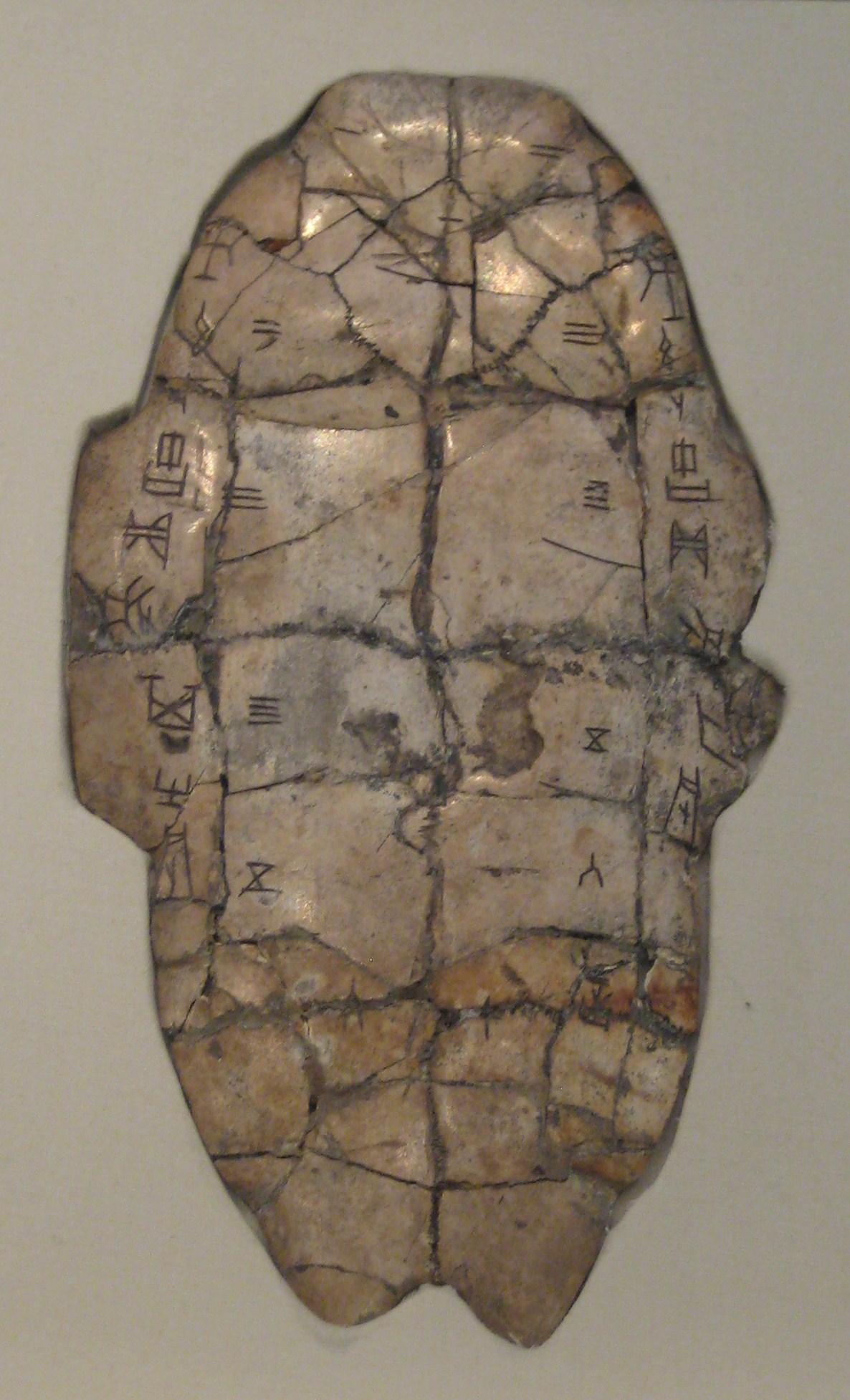
Here's the strangest one. When Shang kings had a big question, like "will the harvest be good?" or "should we go to war?", their priests would press a red-hot point into an ox bone or a tortoise shell until it cracked. The pattern of cracks was read as heaven's answer. Then they carved the question and the answer right into the bone. These "oracle bones" are the oldest Chinese writing ever found. And here's the amazing part: the script has changed so little that a Chinese reader today can pick up a 3,000-year-old bone and still recognise some of the words, like sun, moon, rain and king. Try reading English from just 1,000 years ago; you won't get far.
The Shang were also master metalworkers. They cast huge bronze cooking pots on four legs, and wine vessels covered in dragons and a staring monster face called the taotie. And the vessels kept growing as the craft improved; by the end of the dynasty, some weighed as much as 200 pounds. Experts say nobody has ever done bronze-casting better, not even now.
And daily life? It revolved around family, including the family members who had died. At feasts, food and wine were first offered to the ancestors before anyone ate. That habit of respecting the departed at the table stuck around through every single dynasty that came after.
Zhou: the Mandate of Heaven and the age of sages
The Zhou [1046 to 256 BC] lasted longer than any other house in Chinese history, and it gave China its most powerful political idea: the Mandate of Heaven. It works like this. Heaven gives the right to rule to the good. When a dynasty turns rotten and corrupt, with its values hitting bottom, it's finished, and heaven hands the mandate to the next house. And tradition says heaven never strikes without warning: a failing dynasty first gets signs, like floods, droughts and earthquakes, and only when the ruler ignores them does the mandate move on. Every dynasty after this rose and fell by that rule, and you'll see it tick like clockwork through the rest of this story.
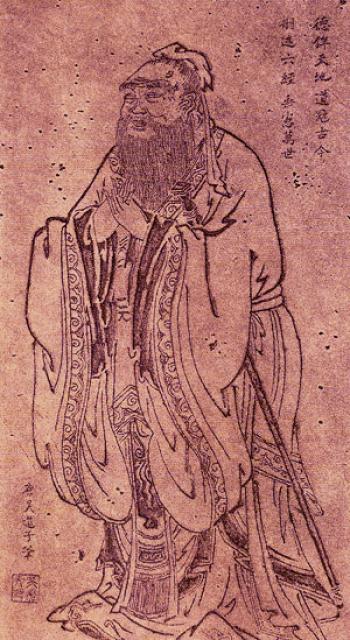
And during the long Zhou centuries came the sages: Laozi and Confucius, Mencius and Zhuangzi, plus a Hundred Schools of Thought all arguing as the kingdom slowly broke into warring states. Confucius taught five virtues that would guide China for the next two thousand years: benevolence, justice, ritual, wisdom and faith. A Zhou gentleman trained in the "six arts": rites, music, archery, chariot driving, calligraphy and maths. Look where music sits: second place. To the Zhou, good music put the heart in order the way good manners put society in order. You simply weren't educated without it.
Qin: the short, iron dynasty
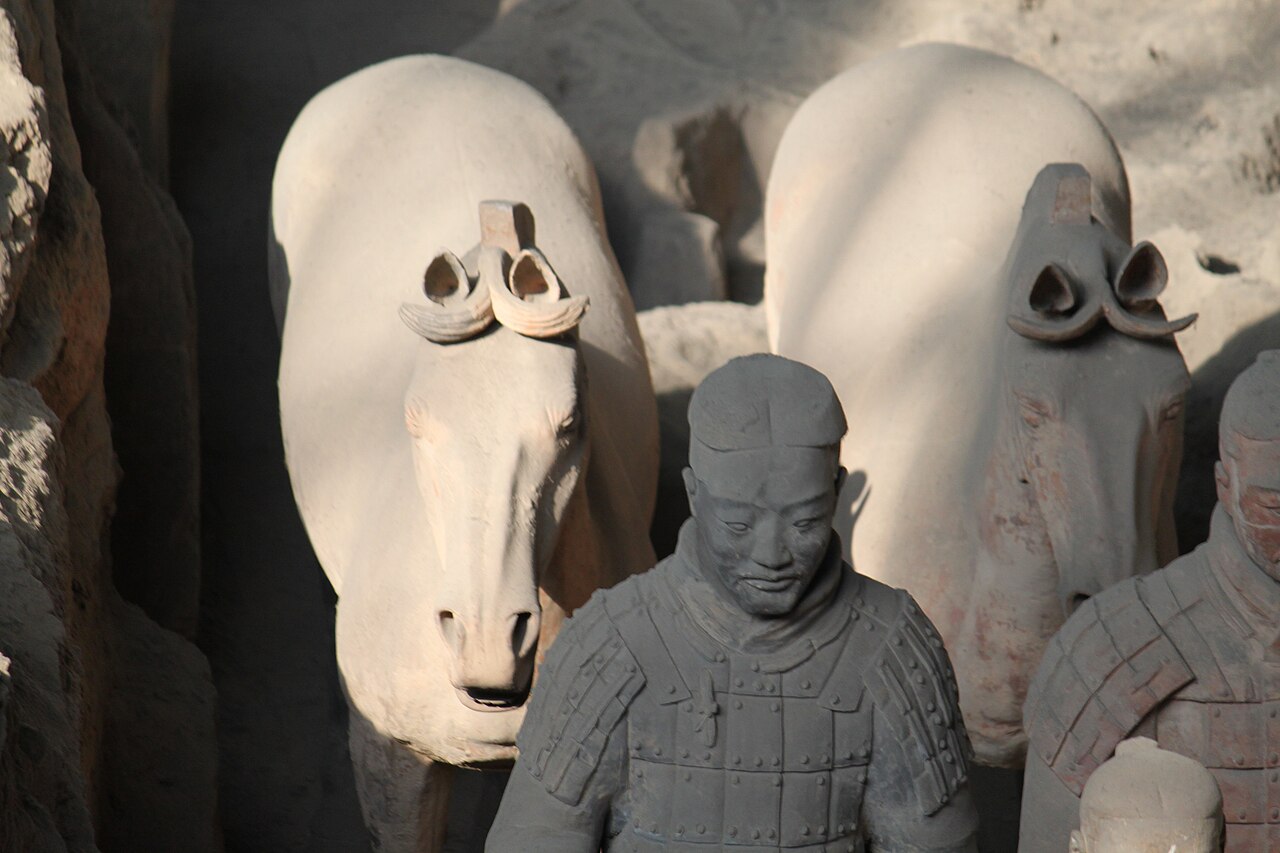
The Qin [221 to 206 BC] lasted only fifteen years. Fifteen! Yet it gave China its name in most of the world's languages. The First Emperor, Qin Shi Huang, conquered all the warring states and then made everything match: one script, one currency, one cart width, one set of weights and measures. He even invented a brand-new title for himself: huangdi, or "emperor", the word every dynasty after him would use. Rulers before him had only been kings. He ruled through a philosophy called Legalism: strict laws, harsh punishments, an efficient court and a frightened people.
And underground, he built an army. Thousands of life-sized clay soldiers, every single one with a different face, buried to guard him in the next world. Whatever you think of the man, stand in front of that army and you'll feel how big the Chinese imperial idea was from day one.
Han: the dynasty that named a people
The Han [206 BC to 220 AD] kept Qin's structure but swapped the cruelty for Confucian learning, and China did so well that most Chinese still call themselves the Han people today, and traditional dress is still called hanfu. The Silk Road opened to the west. Paper was invented in a Han workshop. And scholars started earning government jobs by mastering the classics, planting the seed of the exam system that would shape the Chinese court for the next two thousand years.
Daily life had a steady rhythm: farmers in simple hemp robes, nobles in silk; millet and rice in the pot; the family altar cared for; and everywhere the new Confucian belief that an ordered family makes an ordered empire. If you want to see how deep those roots go, we've explored the rituals of ancient Chinese culture before, and the Han is where many of them settled into place.
Between the great houses: division, and the arrival of the Buddha
After the Han fell, China spent almost four hundred years split apart: the Three Kingdoms, the Jin, then the Northern and Southern dynasties. It was an age of war, but don't picture only ruins. Buddhism travelled the Silk Road into China in these years and changed everything it touched: the art, the buildings, the food (vegetarian temple cooking starts here), even the festival calendar.
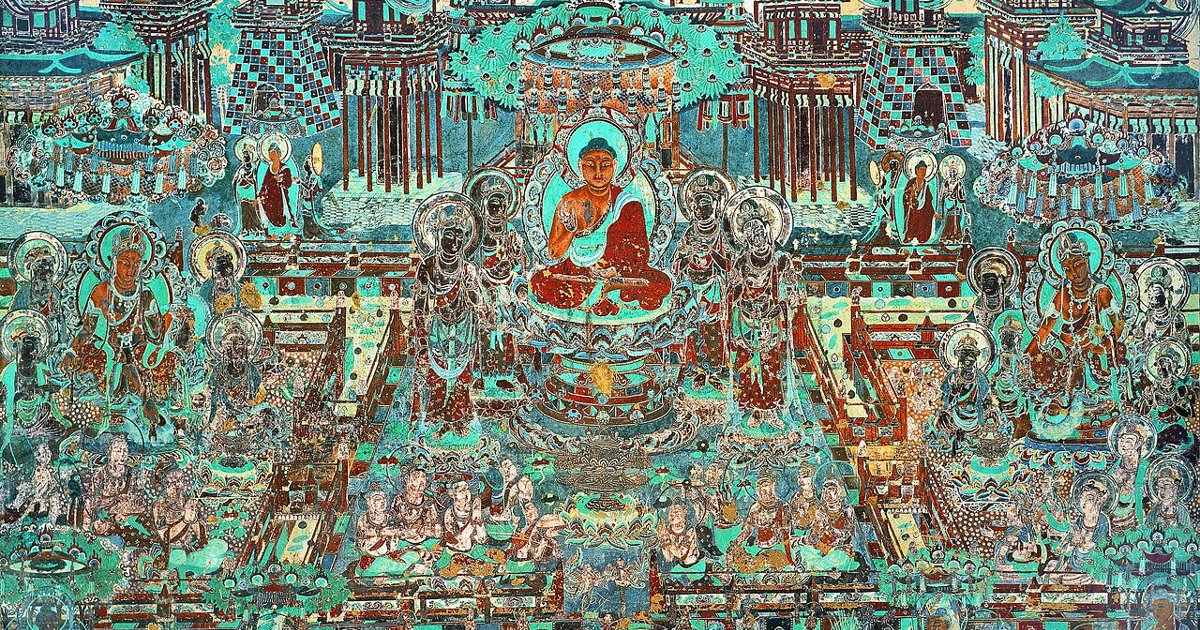
Then, in 366 AD, on a desert cliff near the oasis town of Dunhuang, a wandering monk saw a vision of a thousand Buddhas and carved the first cave into the rock. Over the next thousand years, dynasty after dynasty kept adding to that cliff until it became the Mogao Caves: hundreds of painted cave-temples that are now one of the greatest galleries of ancient art on earth. Remember Dunhuang. We're coming back to it at the story's high point.
Sui: the bridge dynasty
The Sui [581 to 618 AD] gets forgotten the way bridges get forgotten, and it deserves better. In under forty years it glued China back together after centuries of division, dug the Grand Canal connecting the Yellow River to the Yangtze (still the longest canal on the planet), and started the first real civil service exams, which meant, at least in theory, that any talented man with a brush and a good memory could join the court.
But the second Sui emperor burned through lives and treasure the way the First Emperor of Qin had, and the Mandate of Heaven delivered its verdict right on schedule. Worn out and angry, the empire slipped from Sui hands into those of a family named Li. What the Li family built on the Sui foundations became the most loved dynasty in Chinese memory.
Tang: the pinnacle
Ask a traditionalist which dynasty stood highest and you won't wait long for the answer. In the traditional view, Tang culture [618 to 907 AD] is real human culture at its peak: whether in craftsmanship or in the way people carried themselves, everything stood at its greatest height, with a grand, generous spirit and fine, exquisite work that later ages never quite got back.
Look at the evidence and you'll see why nobody argues for long. Chang'an, the Tang capital, was the largest city in the world, laid out like a giant chessboard, where Persian merchants, Japanese students, Turkic generals and Indian monks all walked the same streets. Tang poetry, from Li Bai's moonlit wine to Du Fu's sorrow over war, is still the gold standard of the Chinese language. Tang women rode horses, played polo, and wore bold, colourful gowns that would shock the stricter centuries to come. Even tea became an art in the Tang; the world's first book about tea, the Cha Jing, was written in this dynasty. We've taken a full walk through daily life in the Tang dynasty before, if you want the street-level view.
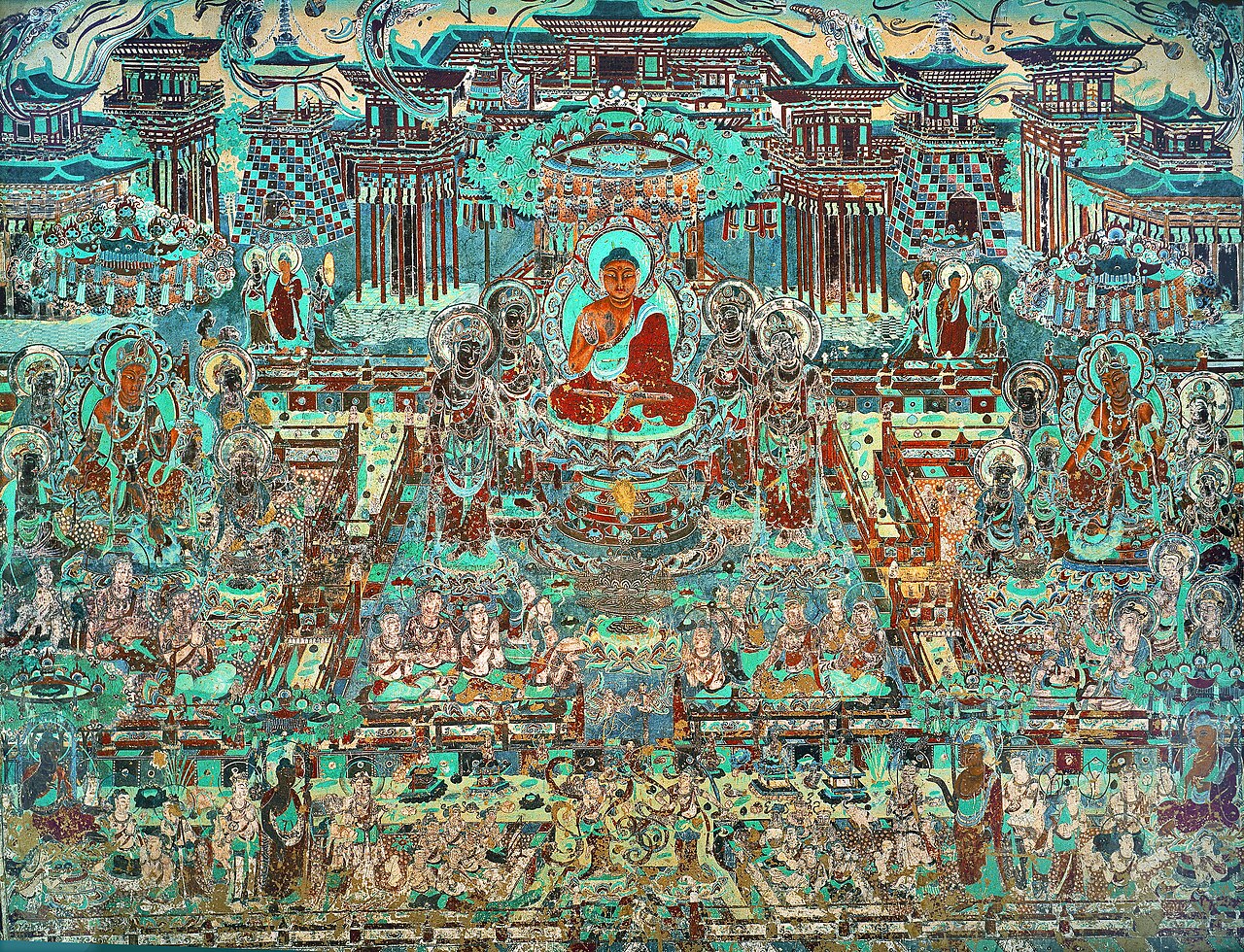
And the art? Go back to Dunhuang. The Buddhas and bodhisattvas painted in the Tang caves wear layer upon layer of adornments: crowns, jewelled necklaces, ribbons and flowing heavenly scarves, painted with such confidence that the figures feel less like pictures and more like visitors. The mural above, from Cave 217, shows a Buddhist paradise imagined as a jewelled palace. Painters copied these scenes for centuries afterwards.
Remember the old belief we opened with, that each dynasty's culture came down with its own group of heavenly beings, bringing their own dress, habits, food and homes? Stand in a Tang cave at Dunhuang and you can at least understand why people believed it.
Five Dynasties, and the two Songs
When the Tang curtain fell, five short-lived dynasties hurried across the stage in just fifty years. Then came the Song, and with it a different kind of greatness: quieter, cleverer, more about city life.
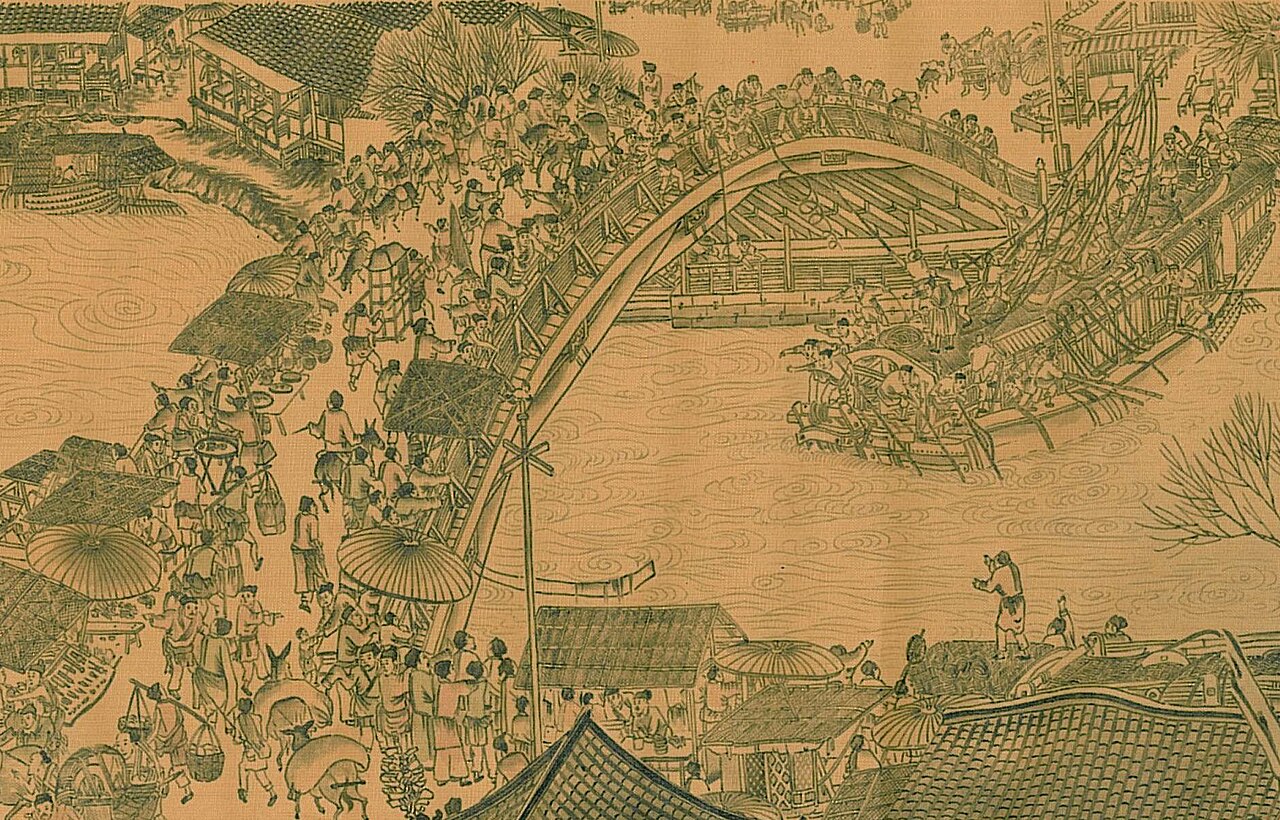
The Northern Song [960 to 1127] ran its empire from Kaifeng, and we know that city's daily life better than almost anywhere else in the ancient world, all thanks to one painting: Zhang Zeduan's scroll "Along the River During the Qingming Festival." Unroll it and you drift past tea houses and noodle stalls, wine shops and fortune tellers, camel caravans, and a crowded arched bridge where a boat is about to smack its mast. This was the first society on earth with printed books in ordinary homes, paper money in ordinary pockets, and night markets that never closed. Song poets perfected the ci, songs written to popular tunes, and Song potters made glazes so subtle that collectors still argue about what colour they are. But the Song never had the north to itself. Beyond the border sat the Liao dynasty of the Khitan people, and after them the Jin dynasty of the Jurchens. It was the Jurchens who stormed Kaifeng in 1126, and their descendants, the Manchus, would one day found the Qing.
The Southern Song [1127 to 1279] began with a disaster. Invaders took the north, and the court ran south to Hangzhou. And then something odd happened: the half-empire grew richer than the whole one had been. New rice doubled the harvests, the world's first permanent navy guarded the coast, and merchant ships sailed as far as Arabia. Southern Song painters turned to misty, almost empty landscapes where one tiny fisherman floats in white space. And a philosopher named Zhu Xi blended Confucius, Laozi and the Buddha into one big system, Neo-Confucianism, that would rule the Chinese mind for seven hundred years. His commentary on the classics became the official textbook for the imperial exams right up until the system ended in 1905.
Yuan: the dynasty from the steppe
Then the Mongols arrived, and for the first time all of China was ruled by outsiders. The Yuan [1271 to 1368], founded by Kublai Khan, plugged China into the largest land empire in history. A Venetian named Marco Polo worked for the Khan and went home with stories Europe flat-out refused to believe: cities of a million people, black stones that burned (coal), and paper that everyone accepted as money.
Here's a pattern worth noticing. Shut out of top government jobs, many Chinese scholars poured their talent into the theatre instead, and Yuan drama became the great art of the age: sung plays about injustice, ghosts and courtroom verdicts that ordinary people crowded in to watch. The ancients would have nodded at that. In the traditional counting, each dynasty gives its own art form: Tang poetry, Song verse, Yuan drama, each one, as the old belief goes, a culture that a different cosmic world brought to human beings. The Yuan also gave us blue-and-white porcelain, Persian cobalt on Chinese clay, possibly the most successful design in the history of ceramics.
Ming: the return, and the turn inward
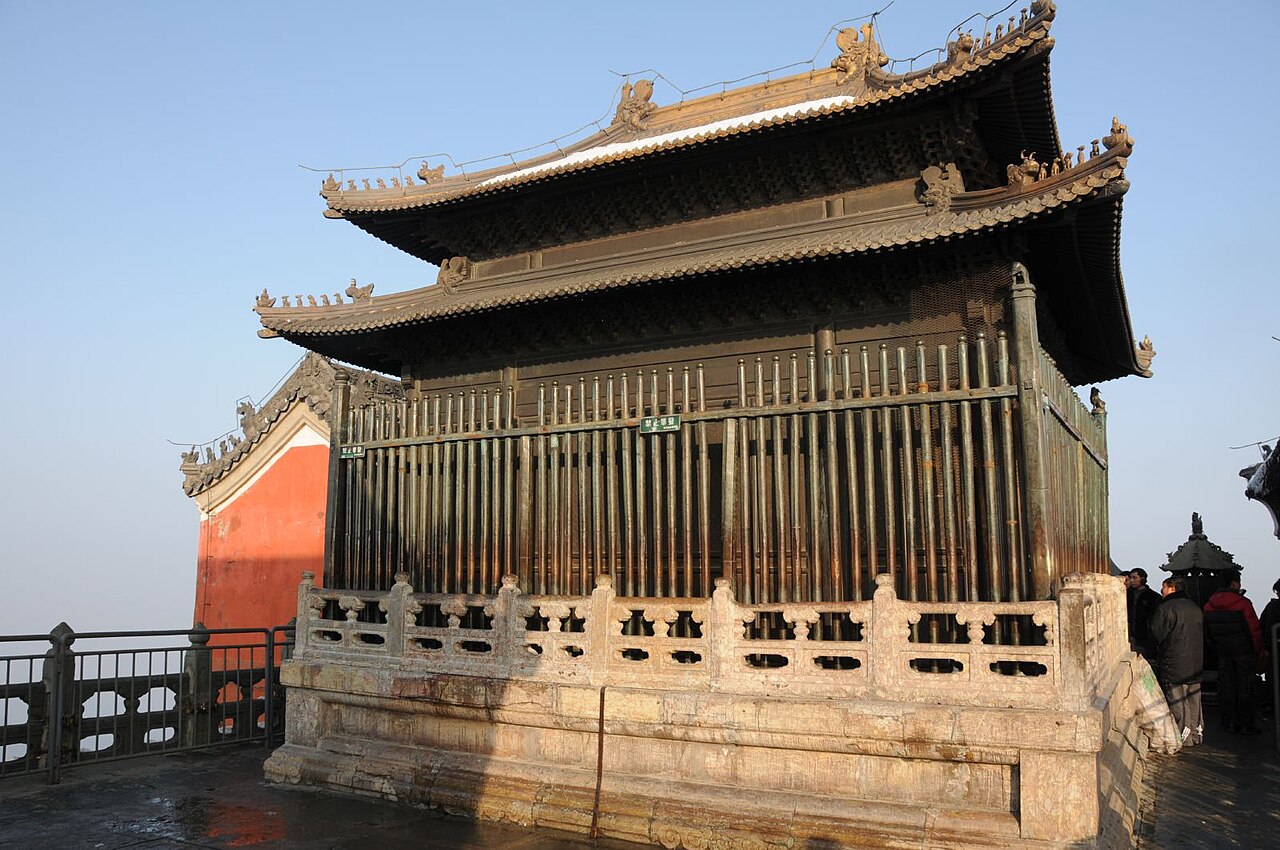
The Ming [1368 to 1644] began with a peasant rebel taking the dragon throne, determined to make China Chinese again. The Yongle Emperor built the Forbidden City, said to have 9,999 and a half rooms, all lined up on a perfect north-south axis following yin-and-yang cosmology (a subject we've explored on its own). The same emperor sent out Zheng He's treasure fleets, ships so huge that Europe wouldn't build anything close for another hundred years, sailing as far as Africa. And on the peaks of Wudang Mountain he built a vast complex of Daoist temples that still stand and still work today, where martial artists train at dawn among the clouds. One more Ming surprise: the Great Wall you see in photos today is mostly Ming work, rebuilt in brick and stone to keep the Mongols out.
Ming daily life gave us things you'd recognise instantly: the great novels (Journey to the West, Water Margin), porcelain so famous that "china" became the English word for fine ceramic, and food spiced up by New World arrivals like chilli and sweet potato. But old-school connoisseurs make a sharp point here. Plenty of Ming and Qing work was very good, they admit, but the grand spirit of the Tang was gone. Artists and scholars zoomed in on smaller and smaller details, beautiful but narrow, and refinement slowly drifted toward the fussy. Agree or not, put a Tang cave mural next to a late Ming carved lacquer box and you'll feel what they mean.
The Ming's own ending followed the old script. A long cold spell shortened the harvests, famine spread, the treasury ran dry, and in 1644 rebels marched into Beijing; the last Ming emperor took his own life as the dynasty fell. The mandate had expired, right on cue.
Great Qing: the last dynasty
The Qing [1644 to 1912] rode in from Manchuria and ruled longer than any conqueror before them. They changed the Chinese wardrobe by law: men had to wear the queue braid and the changshan robe, and the Manchu women's gown later evolved into the qipao that the world now thinks of as classic Chinese dress. Which proves the old saying once more: a dynasty's dress really does belong to that dynasty.
The Kangxi and Qianlong emperors ruled over one last golden age: giant encyclopedias put together by armies of scholars, jade and porcelain workshops of dizzying skill, and a court kitchen whose legendary Manchu-Han banquet ran past a hundred dishes over several days. In the theatres, Peking opera was born under the Qing, its singing carried by the instrument we'll meet in a moment. Near the end of that golden age, Britain sent a trade mission loaded with scientific instruments and manufactured goods. Emperor Qianlong sent them home with a famous reply: "We possess all things. I have no use for your country's manufactures." Within fifty years, that confidence would cost the dynasty dearly. But the Mandate of Heaven kept to its old schedule. Corruption grew, rebellions drained the treasury, foreign gunboats showed up, and in 1912 the curtain dropped on two thousand years of emperors.
Where did the music go?
Here's a question that puzzles a lot of readers: China has five thousand years of music, so why can't we just press play and listen to it? The traditional answer is a sad one. Every time the dynasty changed, the culture changed, and the new dynasty's culture washed away the things of the old one. No dynasty managed to save the heart of the music that came before it. What survived were instruments, scraps and echoes.
But some echoes are amazing. Tang court music travelled to Japan in the 800s and was kept there, note by note, in the emperor's gagaku tradition. And in England, Cambridge scholars led by Laurence Picken spent decades turning those Japanese manuscripts back into playable music, published as "Music from the Tang Court." Think about that journey for a second: music from the Tang capital, kept alive in Kyoto, decoded in Cambridge, twelve hundred years later.
As for instruments, meet the erhu, the two-stringed "Chinese violin" that seems to weep and sing at the same time. Its ancestor, the xiqin, first shows up in Tang dynasty records, brought in by the northern peoples beyond the border. It grew up through the Song, and by Ming and Qing times its family, the huqin, had become the lead voice of Chinese opera. One instrument, five dynasties of polishing.
 Hear it yourself: an hour of erhu music
Watch on YouTube: 1 Hour of Chinese Music for Study, Focus and Calm | Erhu
The curtain falls, the curtain rises
So what should you take away from this long parade? Maybe this: the ancients saw Chinese culture as something handed down to man from above, with each dynasty one scene in a play written on a scale we can barely imagine, and every change of costume, food and song the signature of a different heavenly cast. You might prefer to read it as the normal churn of conquest and renewal. Either way, the pattern itself is real, and nothing else in world history looks like it.
One more thing needs saying. The people of these dynasties were not the backward figures our evolution-tinted textbooks sometimes suggest. They lived, washed, dressed and ate with as much care as we do; a Tang gentleman's grooming would pass inspection today. Much of the break between the Chinese and their own past is actually recent. In the Cultural Revolution of the 1960s, the campaign against the "Four Olds" set out to erase old customs, culture, habits and ideas: braids cut off in the street, heels chopped from shoes, fine clothes cut apart with scissors, temples and treasures smashed. A civilization that had survived the fall of twenty dynasties was badly wounded in just a few years by a campaign run by its own government (we've written about another such campaign before).
And yet the murals of Dunhuang still glow in their desert caves. The temples still stand on Wudang. The erhu still sings. The curtain has fallen many, many times, but on the things that matter most, it somehow keeps rising again. So, which dynasty would you have wanted to live in? We'd pick the Tang. And after this walk together, you probably know why.