 ✦ Home हिन्दी में पढ़ें
  by The Mystical Universe Team · September 24, 2026 · 22 min read
A walnut and a brain. An egg and a mango stone. An atom and the solar system. Some of these look-alikes are real. Some are inherited. And some exist only in our heads. Telling them apart turns out to be the best part of the story.
The shape that never ends (Mandelbrot)
Have you ever zoomed into a photo until it fell apart into blurry squares? Every picture you have ever seen does that. Somewhere there is always a point where the detail runs out.
Here is a shape that does not.
From far away it looks almost boring. A black blob, a bit like a beetle. A big heart-shaped body, a circle stuck to its left side, a thin spike poking out like an antenna, and a row of small bumps around the edge. You could sketch it in a second.
Then you zoom in on one of those small bumps.
The bump has its own bumps. Thin threads grow out of them and curl into spirals. In the gaps between the spirals there are shapes like seahorse tails, or lightning, or the branches of a tree. None of it was there a moment ago. Except it was. It was always there. You just could not see it yet.
So you zoom in again, into one of the spirals. The same thing happens. New shapes, perfectly formed, that nobody has ever looked at before. Zoom again. Again.
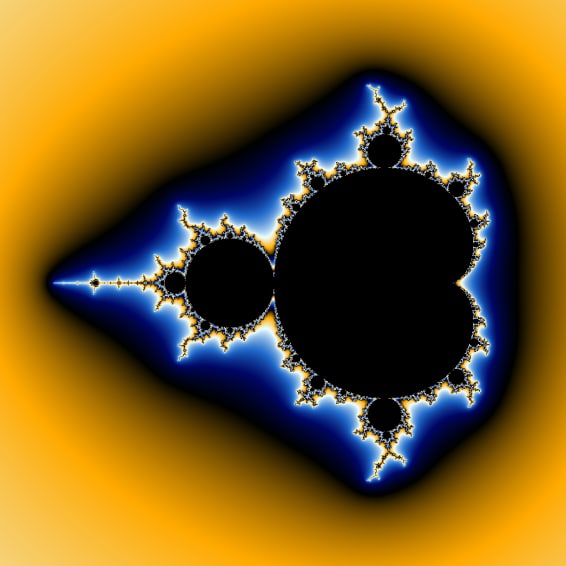
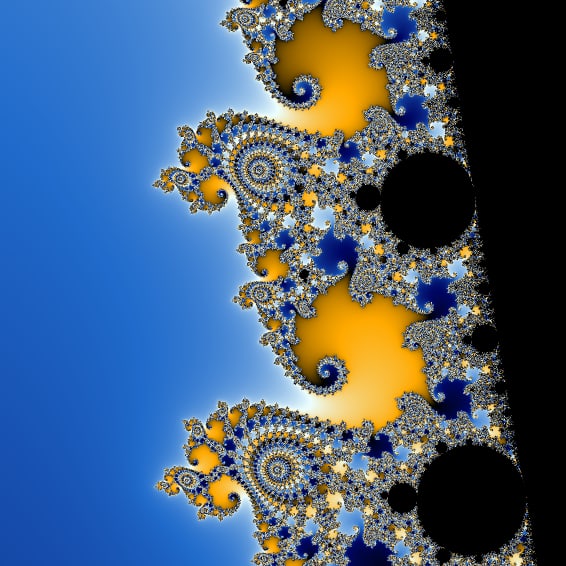
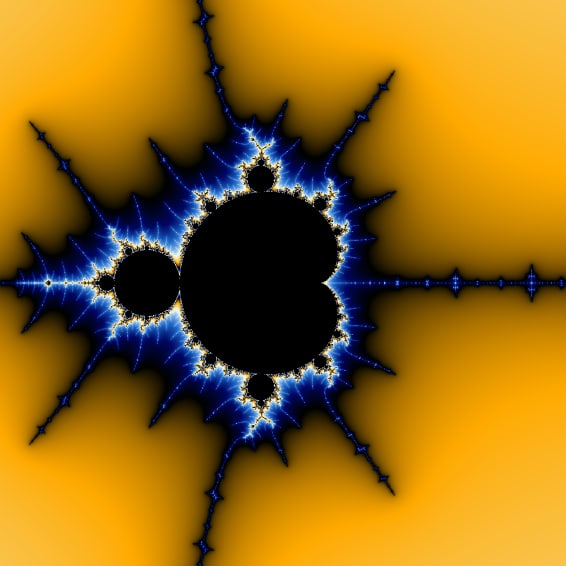
All three pictures are the same shape. Nothing was added in between.
And then something strange happens.
Deep inside a thread, which is a detail of a detail of a detail, you find the beetle. The whole thing. Heart, circle, antenna, bumps. Tiny, but complete, sitting inside its own edge.
Keep going and you find another one. And another. They are everywhere, at every depth anyone has ever looked.
Here is the part people usually get wrong. Those little beetles are not exact copies. Each one is a bit stretched, a bit bent, and decorated differently depending on where it is buried. The shape repeats itself forever, and it never repeats itself exactly.
And there is no bottom to it. That is not a figure of speech.
 Watch: Mandelbrot Zoom Sequence
Watch on YouTube: Mandelbrot Zoom Sequence
Imagine shrinking the entire universe down until it is smaller than a single atom. That is the kind of zoom people have done into this shape, on ordinary laptops. At the end of it, the detail is just as rich as it was at the start. There is no point where the picture goes simple. There is no last layer.
Which leaves one obvious question. What is making all of this?
Benoit Mandelbrot was born in Warsaw in 1924 and grew up in France. He was an unusual mathematician. Most of them think in equations. He thought in pictures, and he liked exactly the things other mathematicians avoided for being too messy: coastlines, clouds, the price of cotton.
In the 1950s he joined IBM, and they handed him a dull problem. Noise on telephone lines was scrambling data, and the engineers wanted it stopped. So Mandelbrot looked at when the errors happened. They came in bursts. Inside every burst there were quiet gaps, and between those gaps, smaller bursts. Inside those, smaller gaps again. An hour of noise looked like a minute of noise, which looked like a second of noise.
He spent the next twenty years finding that same behaviour everywhere. In 1975 he gave it a name: fractals, from the Latin word for broken.
Then in 1980 he used IBM's computers to draw the shape that now carries his name. The first printouts were rough, and there were odd specks scattered around the main blob. He assumed the printer was dirty and asked for them to be cleaned off.
They were not dirt. Every speck was another copy of the whole shape.
z → z² + c
That is it. That is the entire rule. Square a number, add another number, then do it again. And again.
Pick a point on a flat sheet of paper and call it c. Start with z at zero. Now go round and round: multiply z by itself, add c, and the answer becomes your new z.
For some points, z stays small no matter how many times you go round. For others it grows and grows and shoots off to infinity. Once z gets more than 2 away from the centre, it is gone, and it never comes back.
Try c = 1
start with z = 0
0 × 0 + 1 = 1
1 × 1 + 1 = 2
2 × 2 + 1 = 5
5 × 5 + 1 = 26
26 × 26 + 1 = 677
z keeps growing. This point runs.
Try c = -1
start with z = 0
0 × 0 - 1 = -1
-1 × -1 - 1 = 0
0 × 0 - 1 = -1
-1 × -1 - 1 = 0
and on, and on
z bounces between -1 and 0
forever. This point stays.
Now do that for every point on the paper. Colour in the ones that stay. Leave out the ones that run. What you have just drawn is the Mandelbrot set.
One last thing worth knowing. Those famous glowing colours are not the shape. The shape is the black part. The colours only show how fast each point on the outside gave up and ran.
So the beetle is not a picture of anything. Nobody drew it. Nobody designed a single one of those spirals or seahorses or hidden copies. It is just a map of which numbers stay and which numbers run.
And those numbers were doing this long before there was anyone around to look.
Are there more patterns like Mandelbrot?
Here is the strange part. You do not need a computer to see this.
Pull a fern leaf off a plant and look at it. The whole leaf is a stem with small leaves along it. Now look at one of those small leaves. It is a stem with smaller leaves along it. Look at one of those. Same again.
Break off a piece of romanesco, the green broccoli that looks like a cathedral made of cones. Every cone is built from smaller cones, arranged in the same spiral as the whole head.
Look at a tree in winter. The trunk splits into branches, the branches split into twigs, the twigs split again, and every split looks like the one before it.
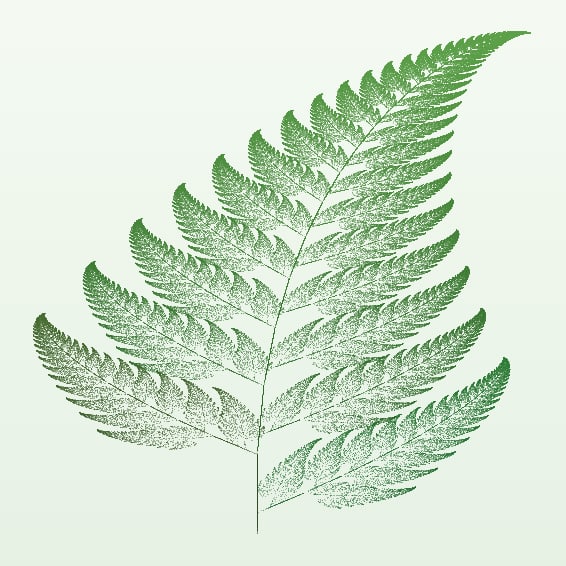
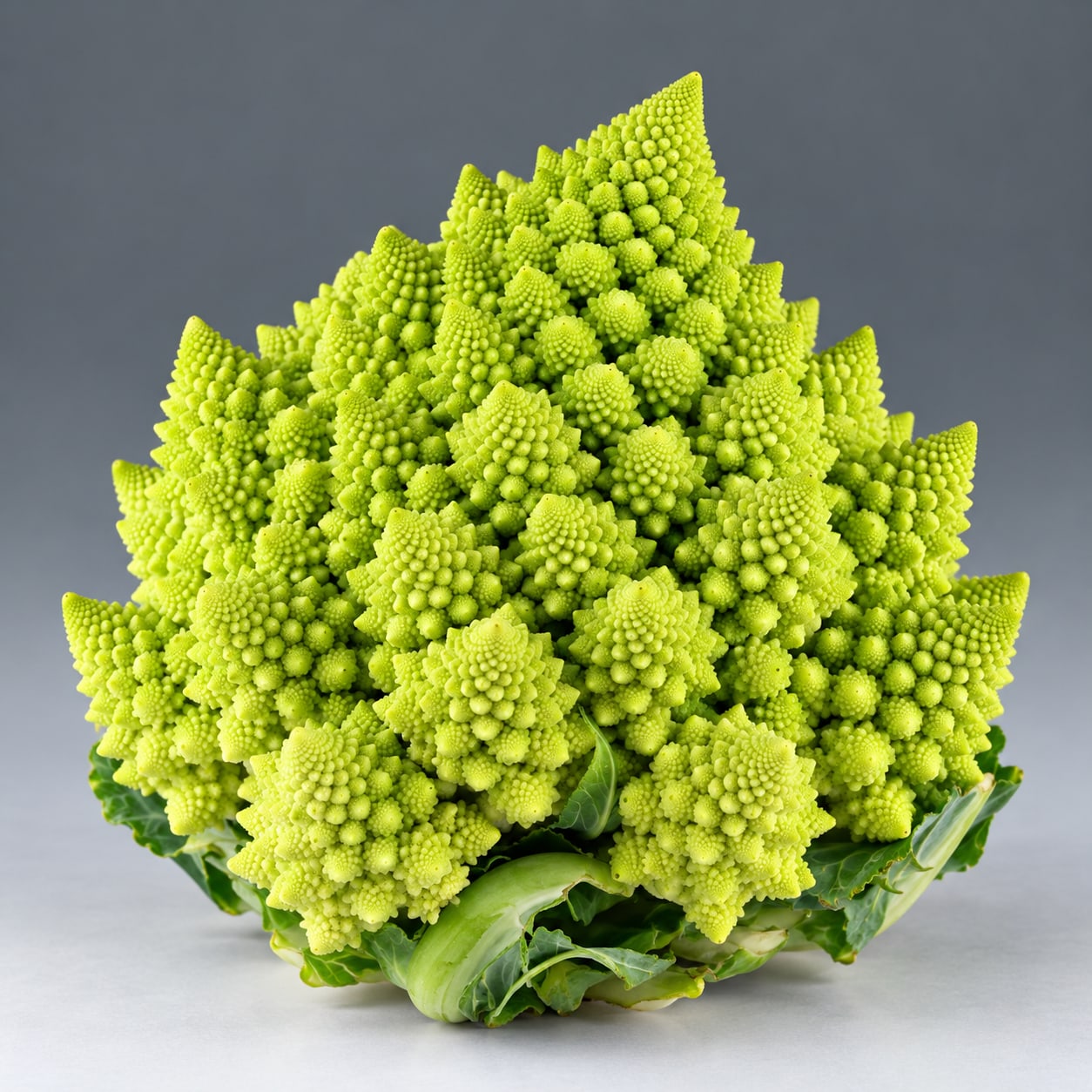
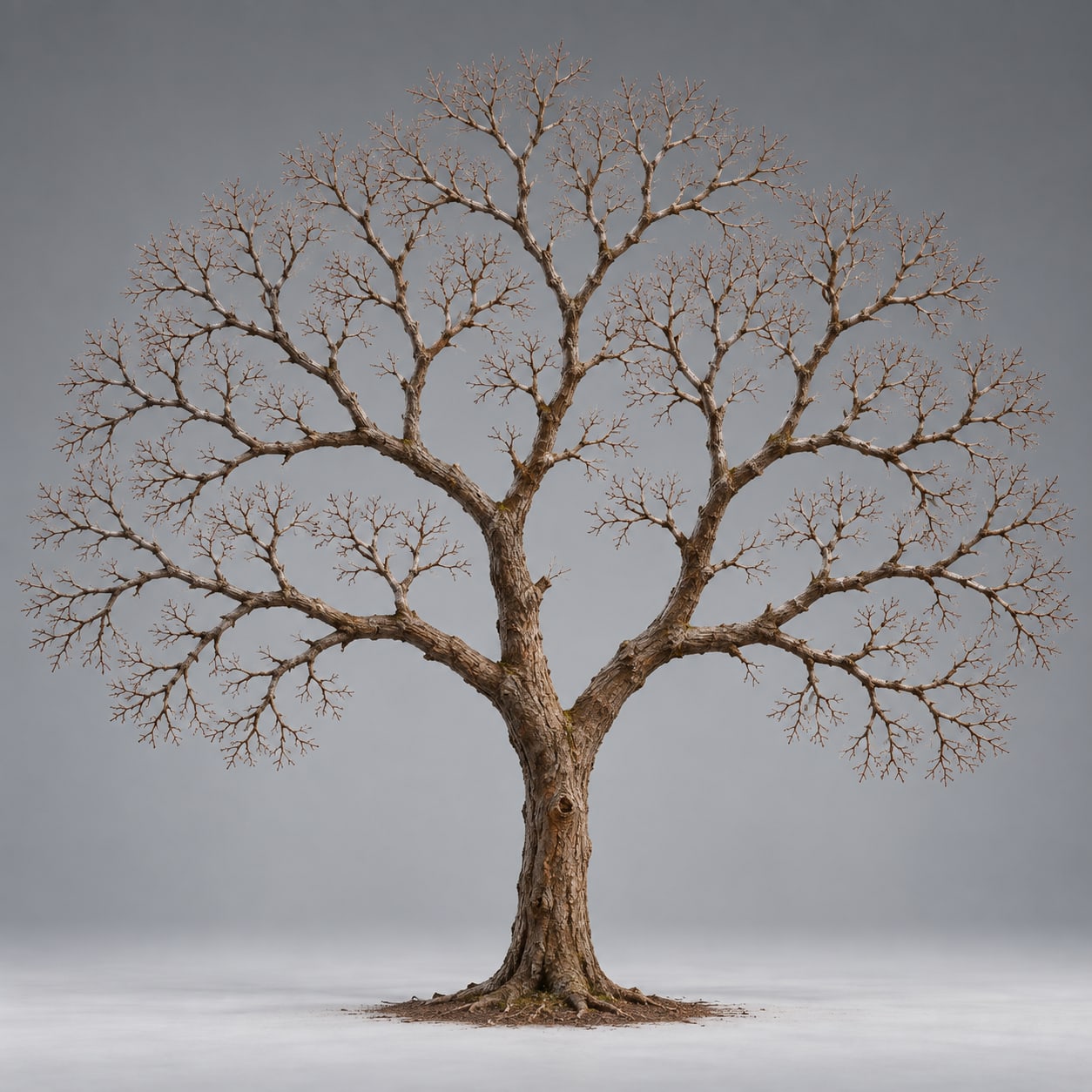
The fern was drawn by a computer from a simple repeating rule.
People noticed this a long time ago
Long before anyone could draw a fractal, people were writing this idea down.
About eighteen hundred years ago, a Buddhist text called the Avatamsaka Sutra, the Flower Garland Sutra, described a universe in which every speck of dust holds entire worlds inside it. And inside those worlds there is dust. And inside that dust, worlds again.
Around the year 700 AD, a monk named Fazang was asked to explain this to Wu Zetian, the only woman ever to rule China in her own name. He did not give her a lecture. He pointed at a golden statue of a lion and told her that inside every part of the lion there is a golden lion, and inside every hair of that lion, more lions again, without end.
Which, if you have just scrolled past the pictures above, is not a bad description of what you were looking at.
And once you start seeing that shape, it gets hard to stop.
Think of the first diagram of an atom you were ever shown at school. A ball in the middle, with smaller balls going round it in rings. Now think of the diagram of the solar system on the wall next to it. A ball in the middle, with smaller balls going round it in rings.
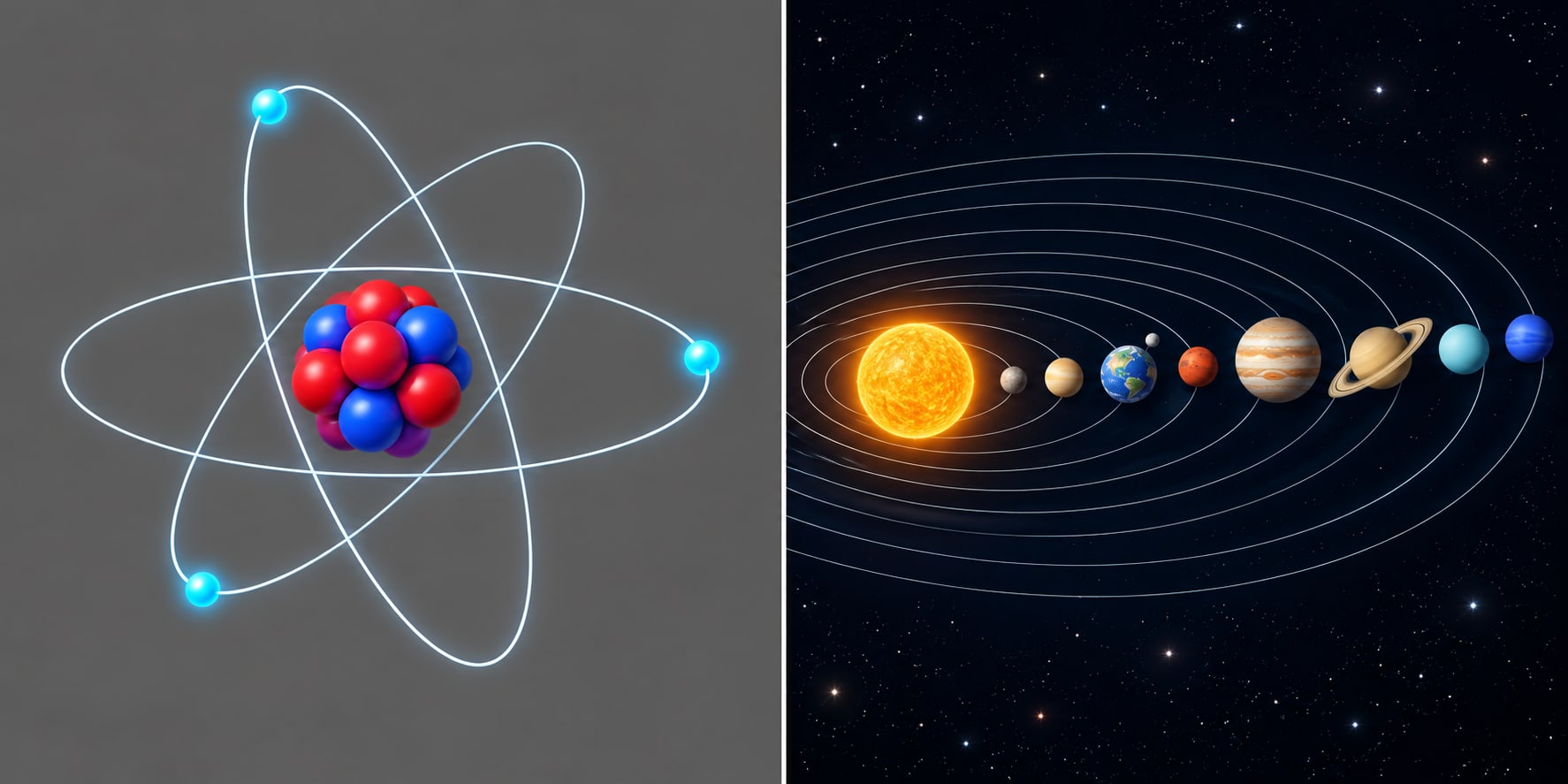
This is the schoolbook atom, and we are using it here only because it is the picture almost everyone carries in their head. Quantum mechanics describes an electron quite differently, as something closer to a cloud than a ball on a track. We are leaving that aside for now. What matters at this point is the resemblance, not the physics.
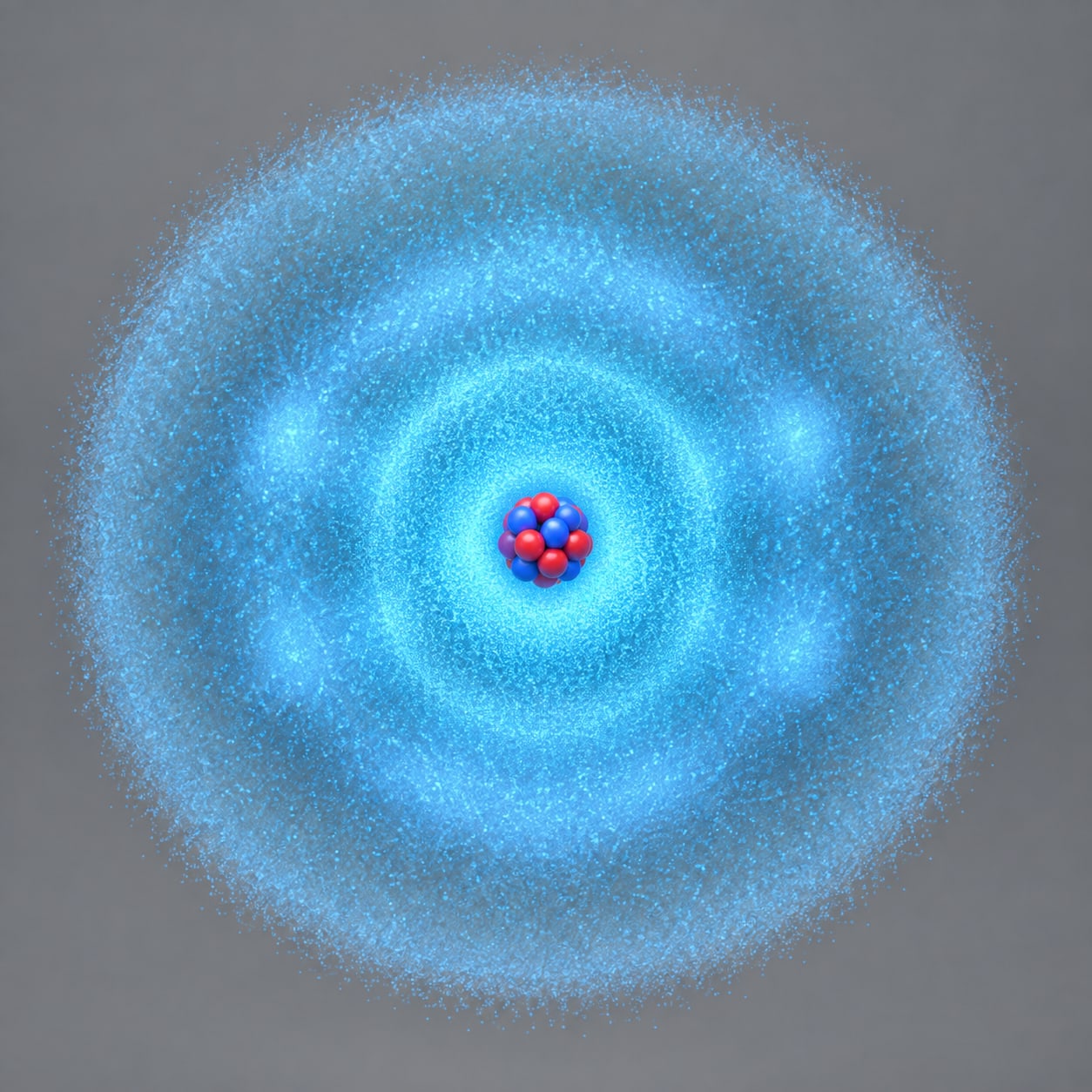
The same picture, at opposite ends of everything. Surely that cannot be a coincidence.
How far down does it go?
So try going the other way. Instead of zooming out, zoom in.
Start with one atom. Almost all of it is empty. If an atom were the size of a cricket stadium, the nucleus at the centre would be about a grain of rice, and everything else would be space. You are built out of these. So is your chair. Solid things are mostly nothing.
Now go inside that grain of rice. The nucleus is a bundle of protons and neutrons, packed tight.
Go inside a proton. There are three quarks in there, held together by something called gluons, which do roughly what the name suggests.
Go inside a quark.
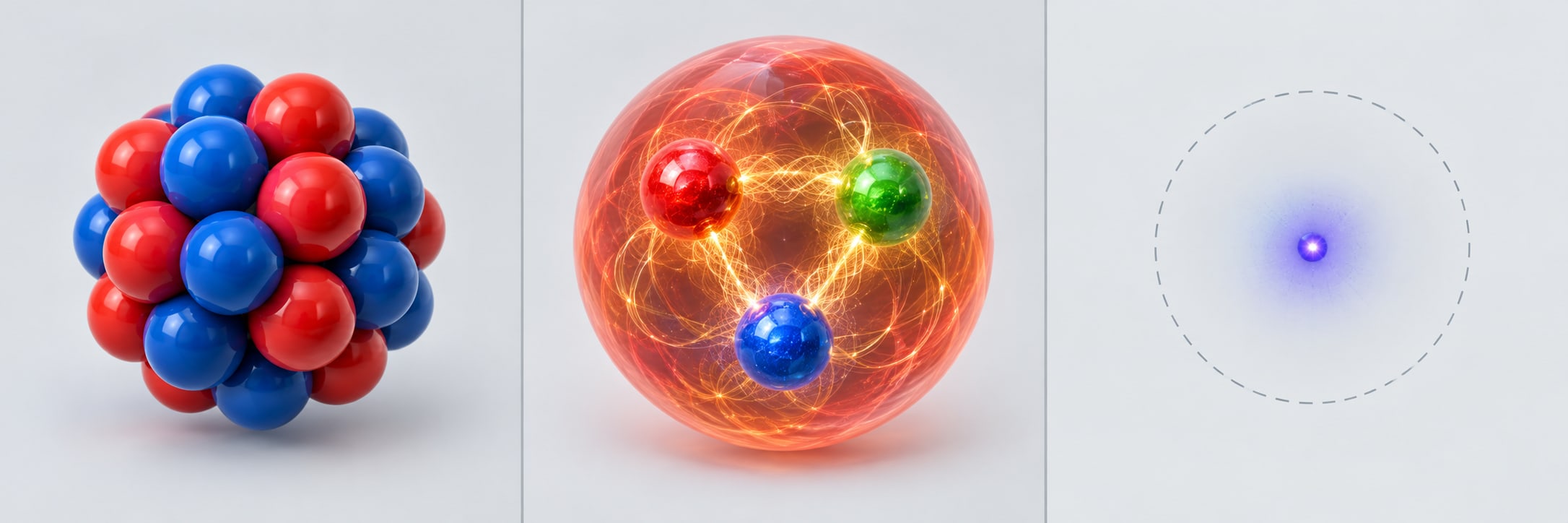
As far as current science can tell, the trail stops here.
Whether that really is the bottom, or simply as far as our machines can currently reach, nobody knows.
And some of what is down there barely notices us. Right now, while you read this, roughly a hundred trillion neutrinos are passing through your body every second. They pour out of the sun, they go straight through the entire planet, and almost none of them touch anything on the way.
And how far up?
Now turn around and go the other way.
The Sun is not a big star. It is an ordinary one. Put the Earth next to it and the Earth is a speck: you could line up about a hundred and nine Earths across the face of the Sun.
Then put the Sun next to Betelgeuse, the red star on Orion's shoulder that you can see with your own eyes on a winter night. Betelgeuse is roughly seven hundred Suns across. If you dropped it where the Sun is, the Earth would be inside it.
And Betelgeuse is not the record holder either.
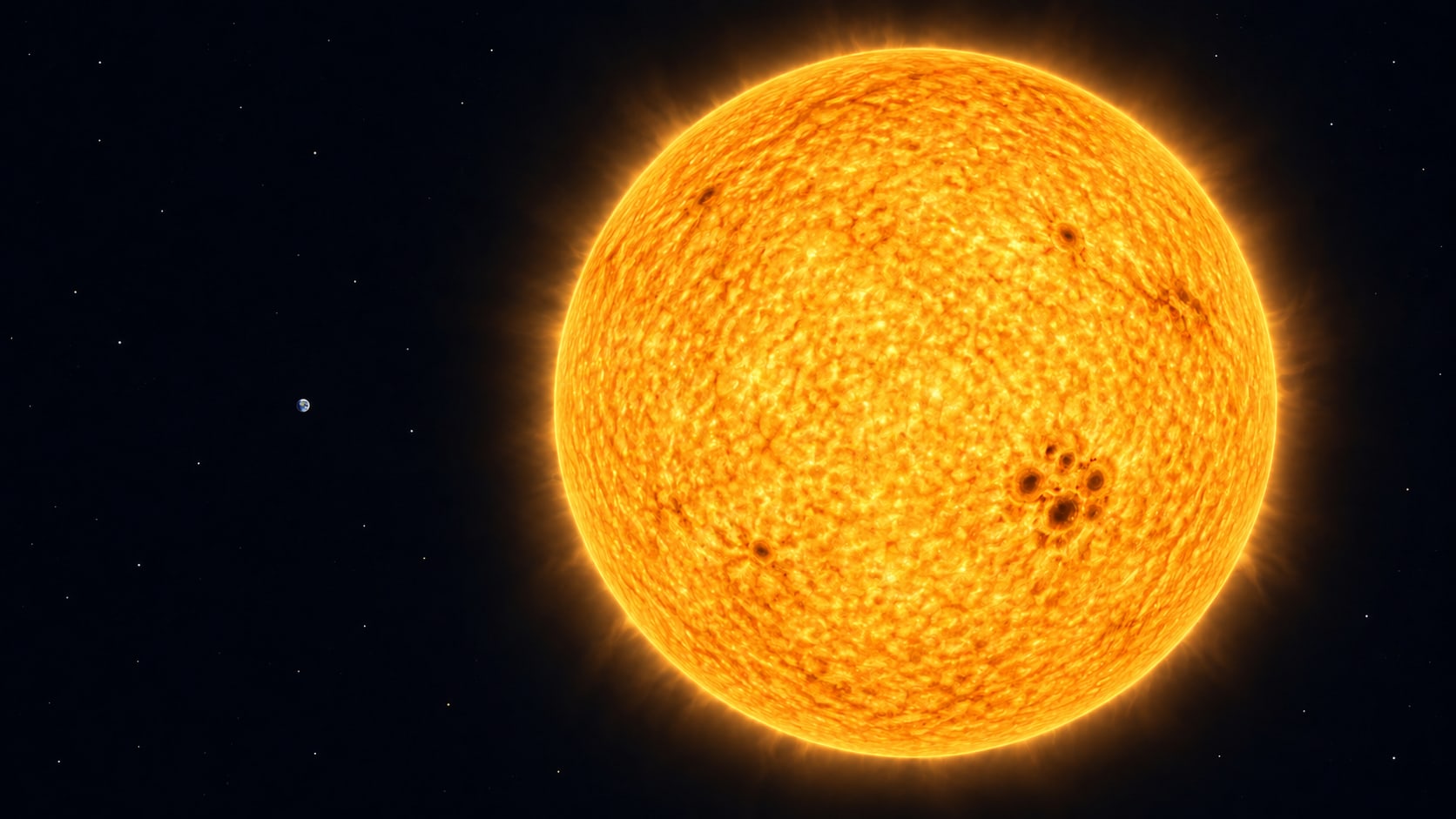
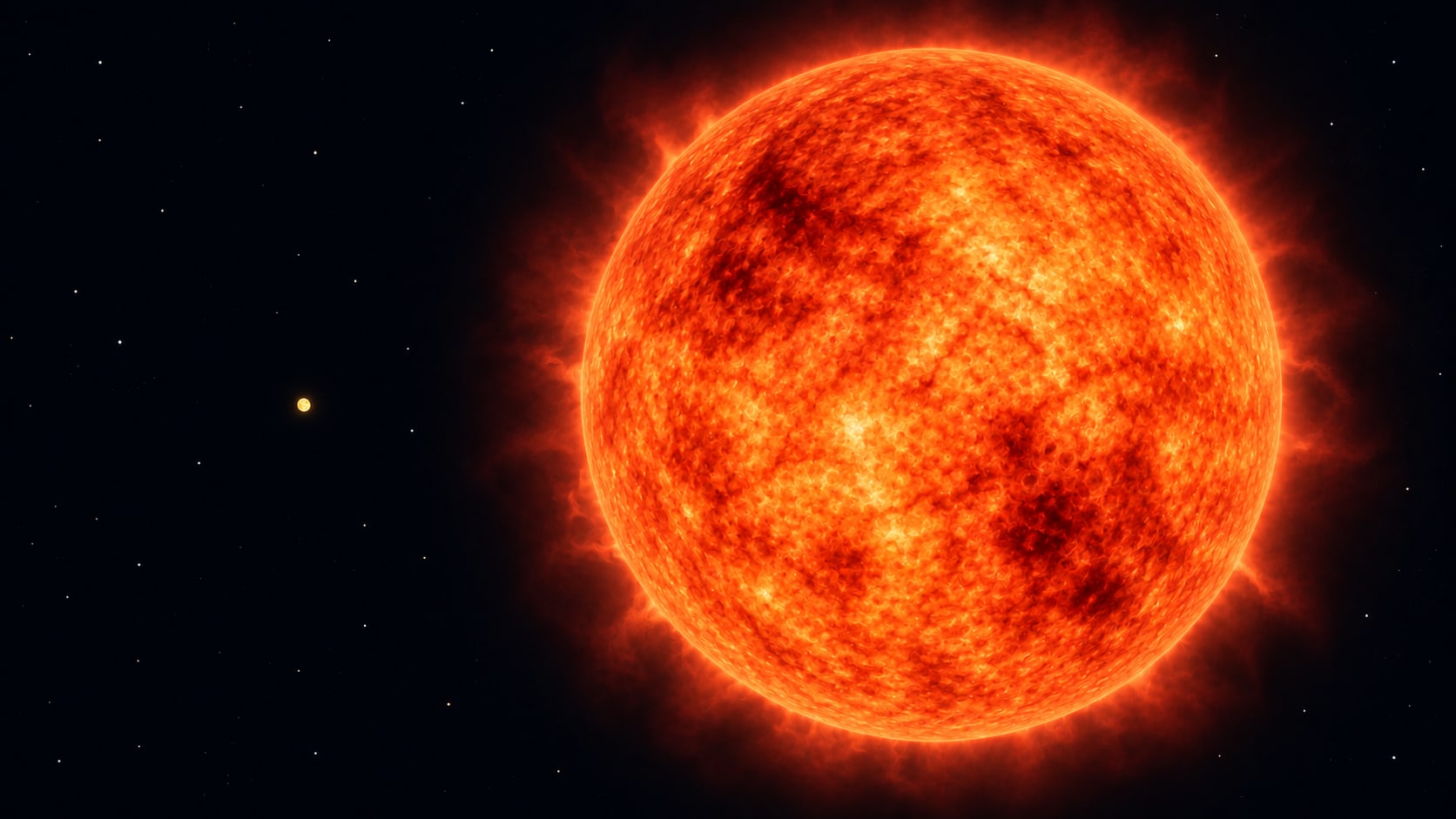
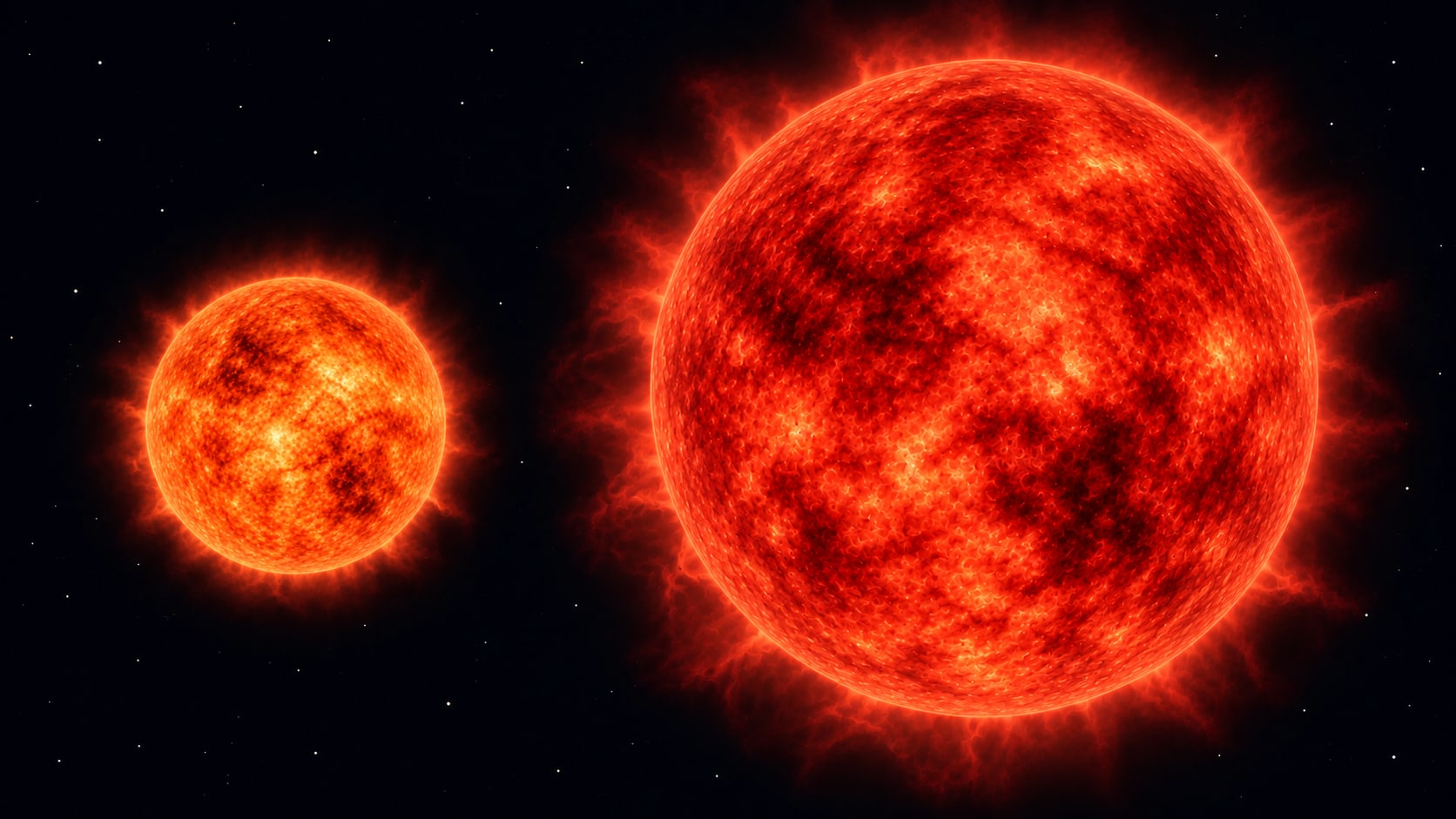
Artist impressions. The frames are not to scale with each other, and the sizes of the very largest stars are still argued over.
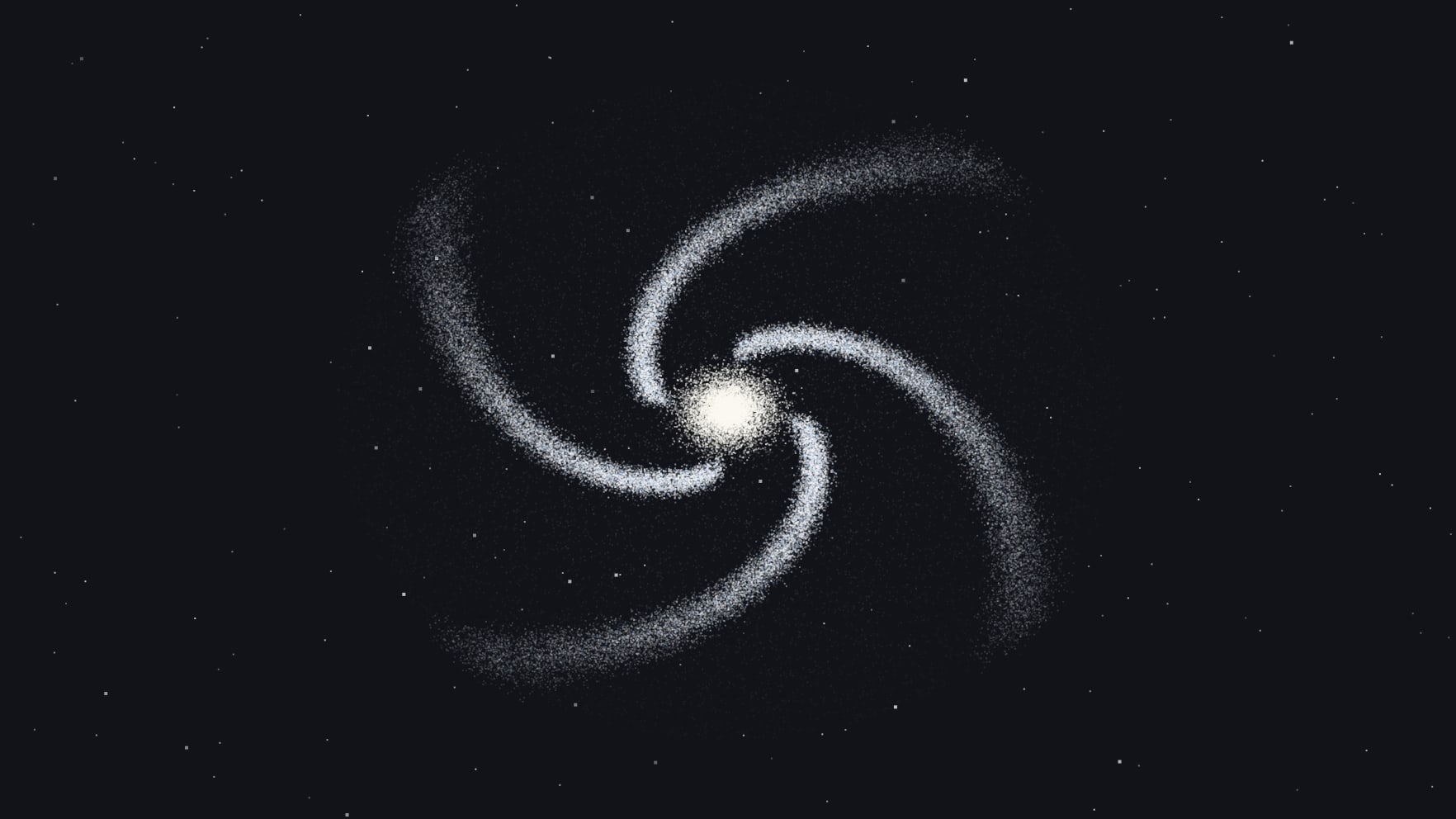
Keep pulling back. Our Sun, with its planets, is itself going round something. It is one star among a few hundred billion in the Milky Way, drifting along an arm, taking about two hundred and thirty million years to complete a single lap of the galaxy's centre. The last time the Sun was where it is now, dinosaurs had not appeared yet.
The third direction
So far we have gone smaller and smaller, then bigger and bigger. But patterns do something else as well, and almost nobody points it out. They repeat sideways. And that is how you get stuff.
Think about gold.
A single gold atom is not shiny. It is not yellow. It is not valuable. It is far too small to be any of those things.
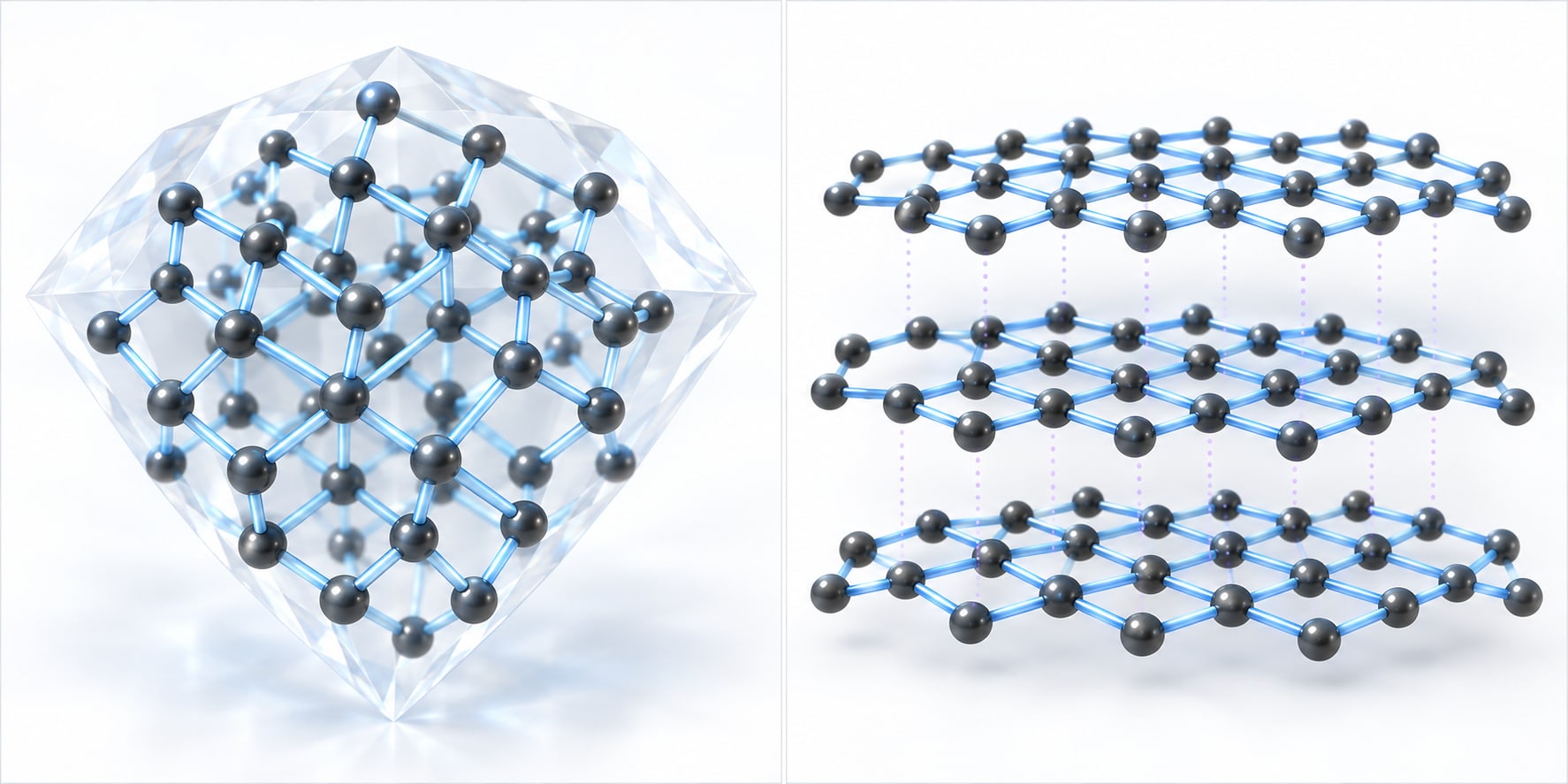
Now stack that atom together with others in a regular repeating grid, cube after cube after cube. Do that about thirty thousand million million million times and you are holding a ten gram ring.
The shine is not in the atom. The colour is not in the atom. So gold is not really the atom at all. Gold is what happens when you stack enough of them in a certain manner.
The clearest proof of this is probably on your desk right now. A diamond and the lead in a pencil are both made of nothing but carbon. The same atom, in both. Stack the carbon one way and you get the hardest thing most people will ever hold. Stack it another way and you get something soft enough to leave a mark on paper.
Which is worth stopping on for a moment.
The beauty is in the pattern. So is the hardness, and the shine, and in the end the price. One of those two ends up in a ring on a wedding day. The other gets chewed at the back of a classroom.
Patterns are not just something to look at. They are what makes a thing what it is, and quite often what makes it worth anything at all.
Where did the gold atoms come from in the first place? Not from here, and not from any ordinary star. Gold takes something far more violent.
Two dead stars, collapsed and impossibly dense, smashing into each other.
In 2017 astronomers watched exactly that happen and measured the heavy elements thrown out of the wreckage. Every gram of gold on this planet, in every ring and every bank vault, was forged in a collision like that, long before the Sun existed, and then swept up into the rock that became the Earth.
It sounds like a creation myth. It is also the one claim in this article that was watched as it happened, live, by instruments on Earth.
Why we cannot see all the patterns
Your eyes are good, but they have a floor. Hold something close and squint, and the smallest thing you can make out is about a tenth of a millimetre. An atom is roughly a million times smaller than that.
This is not a problem you can solve by building a better microscope.
Ordinary light travels in waves, and those waves are thousands of times wider than an atom. Trying to see an atom with light is like trying to find a grain of sand by feeling for it with a cricket bat.
It is not that nobody has managed it yet. It cannot be done that way at all.
So everything you believe about the very small and the very large reached you through a machine, and then through somebody's drawing of what that machine reported.
Which is how a picture can be wrong for a hundred years, and almost nobody notices.
So that is three directions, and we have now been down all of them.
Down into the very small: atom, then nucleus, then proton, then quark, and then a wall we cannot get past.
Up into the very large: moon around planet, planet around star, star around galaxy, and no wall in sight at all.
And sideways: one atom, repeated and repeated, until it becomes a ring, or a pencil, or you.
The old names for the first two were the microcosm and the macrocosm, the world in miniature and the world writ large. People have been pointing at this for a very long time.
Everything begins the same way
Now let us look for patterns somewhere else entirely: in the way every life begins.
Have you ever noticed that almost nothing in nature is born out in the open?
Crack an egg into a pan. There is the shell you just broke. Inside it, a clear jelly. And sitting in the middle of that, the yellow yolk, which is the food, with the beginnings of a bird on it.
Now cut open a mango. Skin on the outside. Then the flesh, which is the part you actually wanted. And in the middle, a hard flat stone, and inside that stone, one seed. One future tree.
Now think about how you started. A bag of warm fluid, inside your mother, with you curled up in the middle of it and fed through a cord.
Three completely different things. A bird, a tree, a person. Look at what is going on inside each one and you get the same picture.
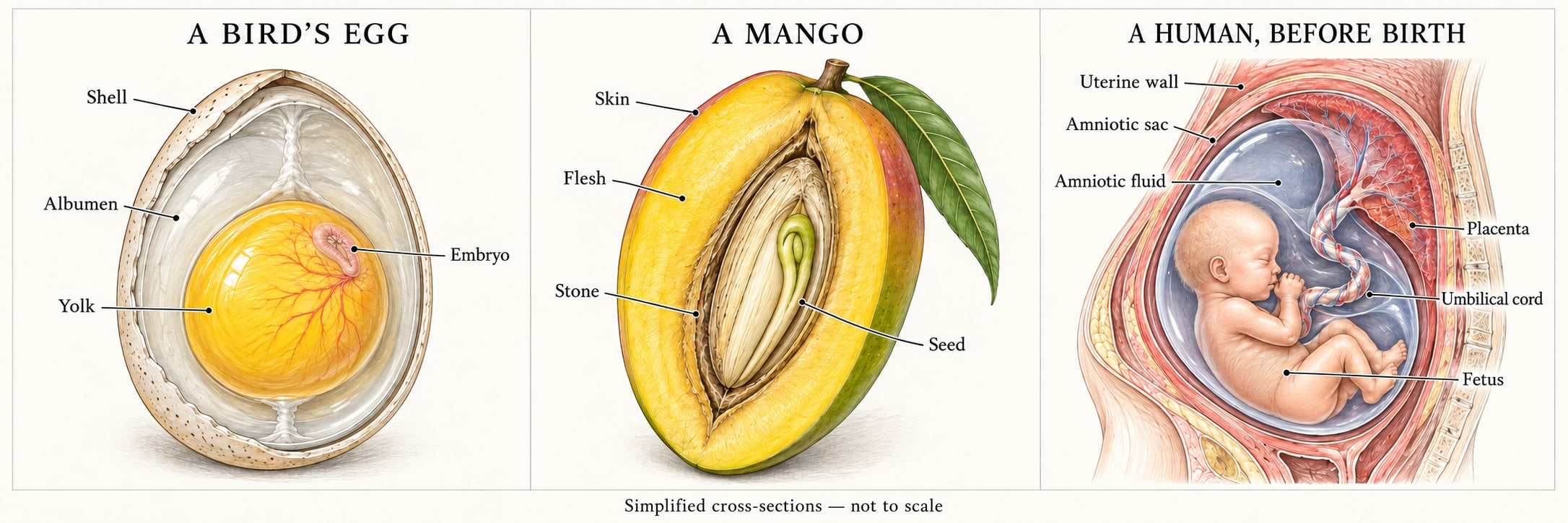
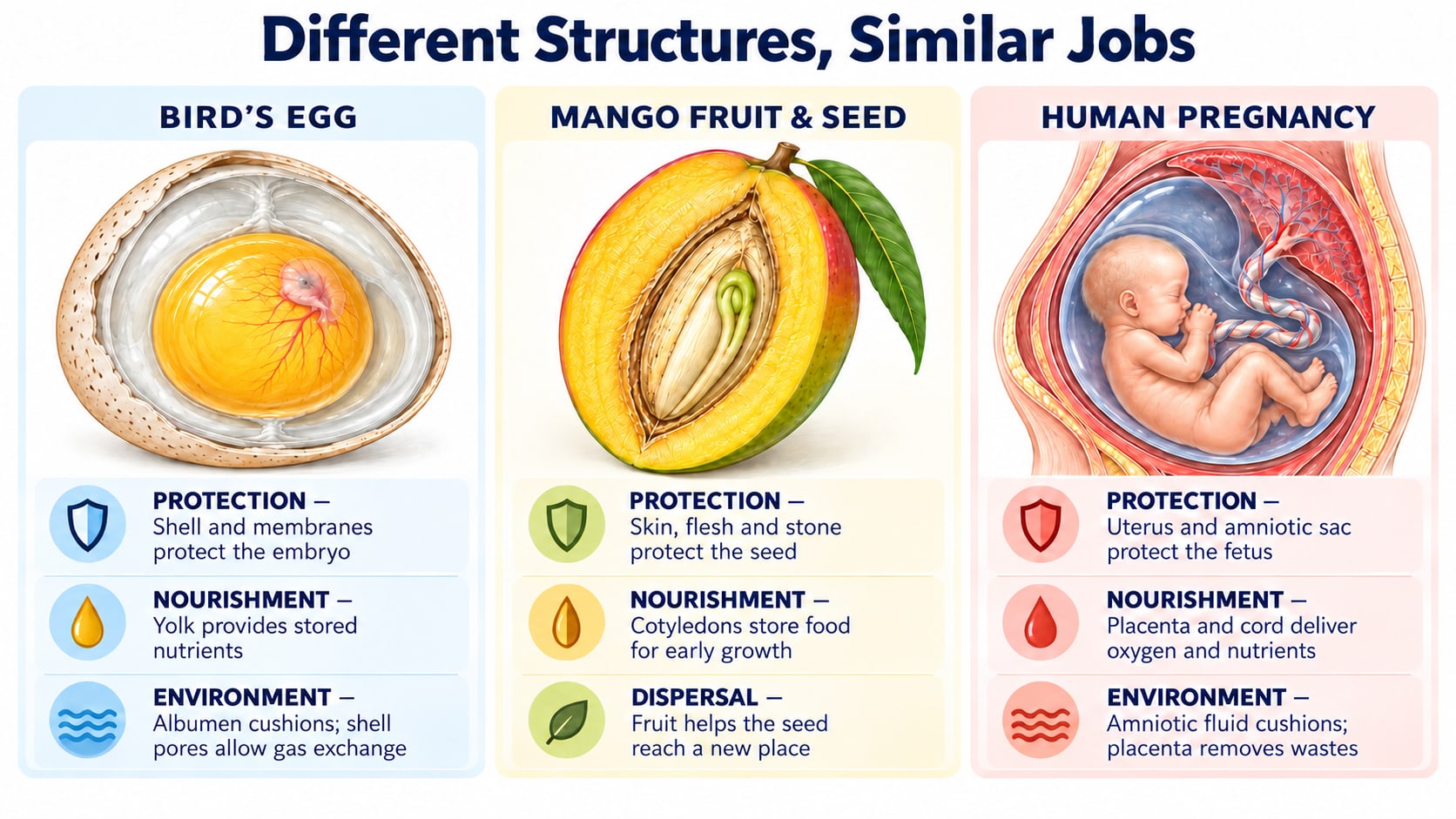
Something small and alive at the centre. A supply of food, either packed around it or piped in. Something soft to cushion it. And a tough outer layer holding the whole arrangement together.
Nobody agreed on this. A mango tree has never met a chicken. The last ancestor a plant and an animal had in common was a single cell floating in water more than a billion years ago, and it had none of these parts.
So why does the same picture keep turning up?
Except one of these three is not a coincidence.
The bag of fluid you grew in has a name. It is called the amniotic sac. And a bird's egg has exactly the same thing inside it.
Not something similar. The same structure, inherited from the same ancestor, somewhere around three hundred and forty million years ago.
That ancestor's descendants are called amniotes, and they are the reptiles, the birds and us. Before them, animals had to go back to water to lay their eggs, the way frogs still do. The sac was the invention that let a creature carry its own private pond around with it, and walk inland for good.
So a chicken's egg and a human pregnancy are related. Actually related, with a family tree you could draw.
The mango just worked it out on its own.
Why only talk about science? Let us also see what history and religion say
Here is the part that is harder to explain away.
Long before anyone thought to cut open a mango and compare it with a chicken, people all over the world were already telling the same story about how everything began. And it was not a story about a builder. It was a story about hatching.
In India, the oldest version is in the Rig Veda, which speaks of Hiranyagarbha, the golden womb, which arose in the beginning before anything else existed. Later texts turn it into a golden egg that splits in two, and the word for the whole universe becomes Brahmanda (ब्रह्माण्ड), which means, literally, the egg of Brahma: ब्रह्म (Brahma) and अण्ड (anda, an egg). The Chandogya Upanishad describes the two halves of the shell: one silver, which became the earth, and one gold, which became the sky.
In China, they told of Pangu. In the beginning everything was mixed together inside something shaped like a hen's egg. Pangu grew in there for eighteen thousand years, then broke it open. The light part floated up and became the sky. The heavy part sank and became the ground.
In Greece, the Orphics said a silver egg was laid in the darkness, and the first god came out of it.
In Finland, the Kalevala tells of a duck that laid its eggs on the knee of a goddess floating in the sea. The eggs rolled off and broke. The bottom of the shell became the earth, the top became the sky, the yolk became the sun and the white became the moon.
In Egypt, the sun itself was said to have hatched.
None of these people were talking to each other (we have written about these creation legends before).
Now, you could say the obvious thing here, and the obvious thing is probably right. Everyone has seen an egg. Everyone has seen something come out of one alive. It was the only object any of them had ever handled that turned nothing into something.
But it is still worth noticing what they were all claiming. Not that the world was built, or made, or assembled by somebody. That it was born. That it came out of something, the way you did, and the way the bird does, and the way the tree does.
We are going to keep moving between science, history and religion all the way through this article, so it is worth pausing on one more thing here.
Buddhism does not treat birth as a single event that happens to you once. It describes six paths of samsara, six places a life can be born into and born into again: gods, demigods, humans, animals, hungry ghosts and hell beings. Birth, in that view, is not a starting line. It is a wheel.
And in the older Buddhist texts there is a detail that is hard to read without stopping. They sort every living thing by the manner of its birth, into four kinds. The egg-born. The womb-born. The moisture-born. And those that simply appear.
The first two on that list are the first two pictures in this section.
Cut open an egg. Cut open a mango. Then look at a scan of a baby before it is born. The cross-section is the same picture three times. Something alive at the centre. Food. Something soft around it. Something tough around that.
And long before anybody could know any of this, people on every continent were already telling the same story: that the world did not get built. It hatched.
The walnut and the brain
Now another one, and this is the one nearly everybody has noticed at some point.
Break a walnut in half. You get two halves, joined down the middle, each one covered in wrinkled folds, with a thin papery wall between them.
Now look at a human brain from above. Two halves, joined down the middle, each one covered in wrinkled folds, with a thin wall between them.
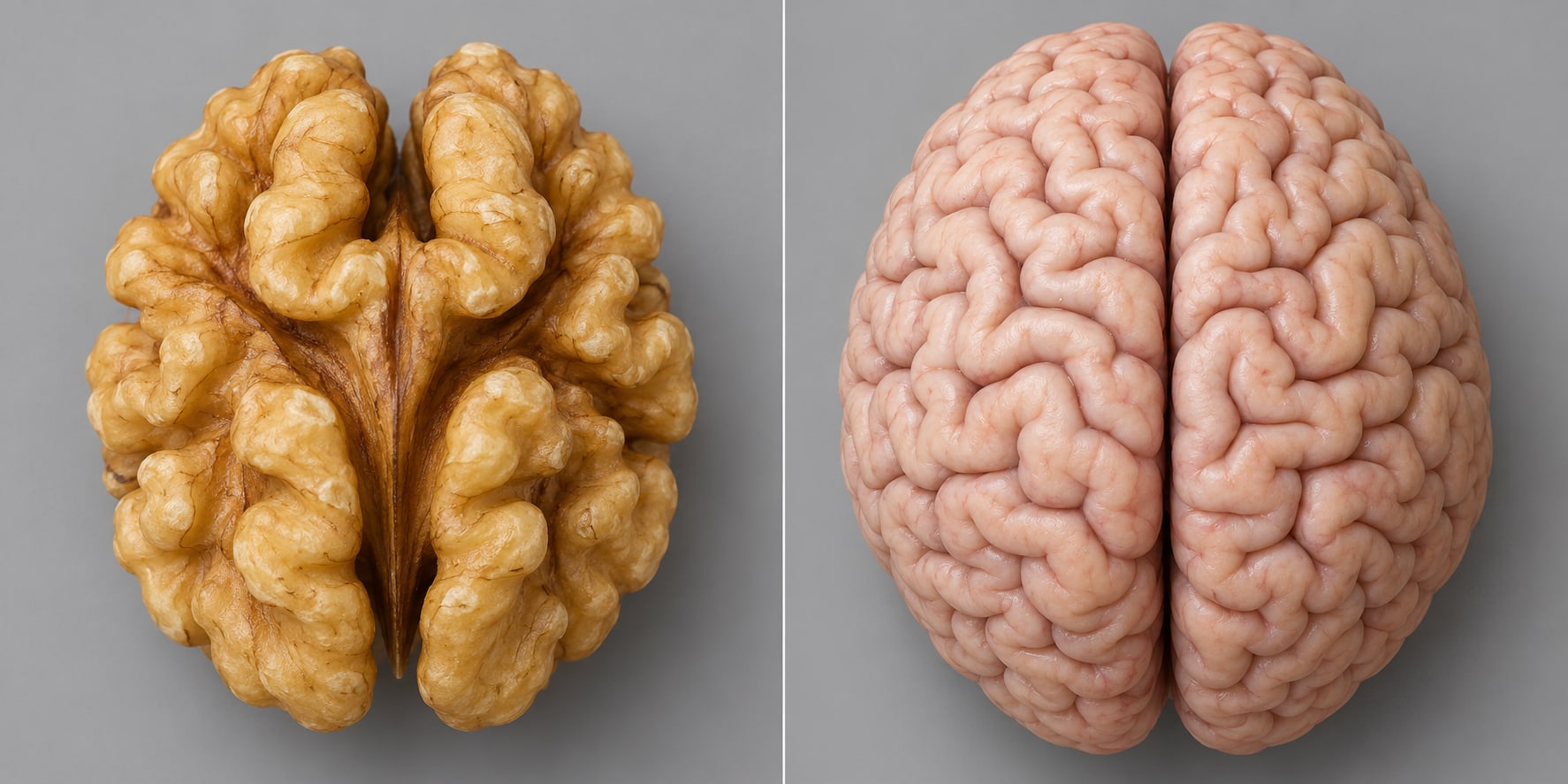
And it does not stop there. A kidney bean has the same curve and the same little notch as a human kidney.
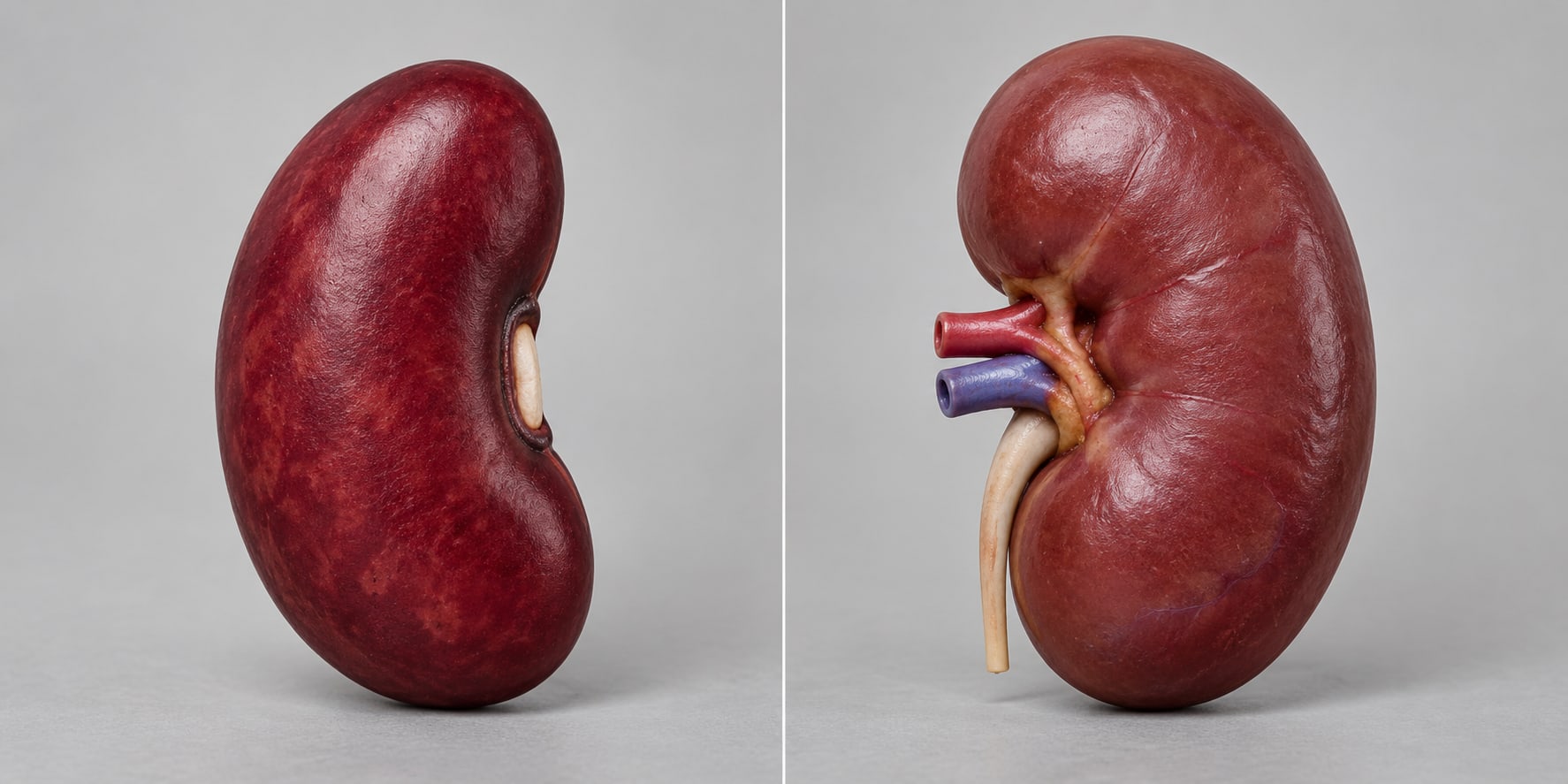
A slice of carrot looks like an eye. A tomato cut across has chambers like a heart. Ginger looks a little like a stomach.
In 1588 an Italian named Giambattista della Porta published a book called Phytognomonica. Its central idea was simple, and at the time it was perfectly reasonable.
Nature, he said, marks every plant with a clue. A visible signature, showing what the plant is for. If a plant resembles a part of the body, it is the medicine for that part.
So the walnut, which looks like a brain, was for the head. It was given for brain complaints and for headaches. Its folds also reminded people of intestines, so it was used for stomach trouble as well.
The kidney bean was for the kidneys. Lungwort, whose leaves carry pale spots that look like diseased lungs, was for the chest. Yellow plants were for jaundice. Hepatica, whose leaves are shaped like a liver, was for the liver.
This is called the doctrine of signatures, and it was not some fringe belief held by cranks. It was mainstream European medicine for centuries. Paracelsus taught it. Doctors prescribed by it.
Reported as history. Not offered as advice.
Over to you
That is where we will stop for Part 1.
We started with a shape that never runs out, and then found the same trick in a fern leaf, a head of romanesco and a bare tree in winter. We went down as far as anyone can go, past the atom and the nucleus and the proton, until the trail stopped at a quark. We went up as far as anyone can see, past Betelgeuse and out to a galaxy turning on its own axis. We watched a single atom, stacked over and over, become a gold ring or a pencil.
Then we looked inside an egg, a mango and a womb, and found one picture three times. And we held a walnut next to a brain, and a bean next to a kidney, and read a book from 1588 that took those resemblances for instructions.
Different explanations have been offered for all of this. Sometimes a shared ancestor. Sometimes two unrelated things arriving at the same answer to the same problem. Sometimes the way human eyes and minds work.
Which brings us back to the question we started with.
Are the universe and nature working from a blueprint?
Is there something behind all this repetition, something that chose the shapes?
Or were there simply never very many shapes available, so everything ended up using the same few?
We would genuinely like to know what you make of it. Tell us through our contact page.
The human eye and the camera. A photograph of a slice of brain that looks unsettlingly like a map of the universe. And more patterns, some real, some not.